Critical thinking isn’t a personality type. It’s also more than a mindset. First and foremost, it’s a disciplined set of habits. To paraphrase James Clear, the author of Atomic Habits, we do not rise to the level of our goals; we fall to the level of our habits. So, it’s not enough to believe in critical thinking; we have to train it like a muscle – it strengthens through disciplined reps. Over time, these routines become second nature, giving our thinking the resilience to hold up under the pressure and pace of daily life.

My last post outlined the critical-thinking mindset in an age of AI. This one outlines nine habits to help embed that frame of mind into your daily routines.

1. Read, listen and watch widely

Critical thinking is not a free-floating technique; it’s a proactive engagement with facts, information and opinions. Critical thinkers don’t just passively consume their ‘filter bubble’ feed — they select a range of perspectives that stretch and refine their understanding. A broad information diet helps them spot patterns, contextualise evidence, and know exactly where to probe and what to ask.

They actively seek out clever people and opinions, including those they disagree with. Comfortable with their assumptions being tested, not coddled, they are open to sharpening their opinion in the face of new information or a more compelling argument. They see changing their mind as growth and progress, rather than a sign of weakness.

Discomfort is data — pay attention to it.

2. Adapt to the specific context

Sound decisions start with seeing the situation clearly and framing the context around the subject at hand, which determines what kind of thinking the moment needs. Critical thinking isn’t a fixed routine; it flexes to the circumstances. Good thinkers read the room, the stakes and the constraints. They know that every decision sits in a web of agendas, incentives, timelines and imperfect data.

Product teams make hundreds of calls a day. Most don’t need forensic analysis. The real skill is recognising which decisions deserve slow thinking. In his book, Build, Tony Fadell draws a helpful distinction between two types of decision: data-driven decisions, which can be tested with evidence, and opinion-driven decisions, which rely on debate and judgment when data is scarce. Both need critical thinking — but not the same kind. One leans on analytical rigour; the other on challenge and counter-argument.

Critical thinkers match their approach to the moment.

3. Surface your assumptions

Assumptions are the hidden scaffolding of our thinking — the beliefs we treat as obvious that don’t need checking. Making them explicit gives us and our colleagues something to test, challenge and improve.

Every domain has its favourite fictions — here are a few classics from the past:

  • ‘If we build it, they will come’
  • ‘Touch screens will never be good enough to type quickly on’
  • ‘We own the customer, so they’ll use our app store’
  • ‘Our brand perception won’t be a barrier to moving upmarket’
  • ‘Customer service chatbots won’t impact brand loyalty’
  • ‘Younger users don’t care about privacy’

When assumptions lie hidden, they become silent drivers of flawed thinking. We slip into false certainty and mistake belief for fact. Groupthink thrives as premises go undiscussed. And when plans rest on wishful thinking, organisations become strategically blind.

The antidote is simple: surface the assumptions. Log them. Run pre-mortems. Ask ‘What must be true for this to work?’. Expose your assumptions before they expose you.

4. Write it out

Writing, like sketching, is a great way of getting thoughts out of your head and into the world, where they can be more clearly assessed. Just like we clarify design concepts through sketching and re-sketching, we refine more abstract concepts through writing and re-writing. The act of putting words down forces meaning to surface. Writing is thinking in slow motion — it exposes gaps, sharpens intent and turns intuition into reasoning.

Strong thinkers have always known this:

  • ‘If you’re thinking without writing, you only think you’re thinking’, Leslie Lamport
  • ‘I write entirely to find out what I’m thinking. What I’m looking at, what I see and what it means.’, Joan Didion
  • ‘Ideas that are flaky appear even more so when committed to paper. Conversely, ideas that are inherently strong get even stronger through the discipline of writing, ’ Gary Hamel
  • ‘I write because I realised at art school that you can only draw a small percentage of the attributes of an object. If I were to draw a glass, you would understand only 20 per cent of its nature. You would have no sense of its weight, or material, or temperature. You would have no sense of how it reacted to its environment. Writing helps me frame the problem. A lot of mistakes are made when you frame a problem, because you could already be dismissing 60 per cent of the potential ideas.’, Jony Ive

The same logic applies to GenAI. Prompting is writing: the clarity of your input shapes the quality of the output. Loaded questions, hidden assumptions and sloppy framing produce biased or vague responses. And editing GenAI text is non-negotiable. AI has no understanding, judgment or intent — which means you are accountable for the meaning, accuracy and tone of anything you ship.

AI accelerates drafting; writing preserves judgment.

5. Embrace nuance

In polarised and distracted times, the path of least resistance is to let our thinking be framed by headlines and social media hot takes. These perspectives tend towards black-and-white thinking that flattens complex issues into neat binaries. Good vs bad, success vs failure, quality vs speed — these oppositions make conversations easier but decisions worse.

Critical thinkers distrust such Manichean simplicity. The truth and wise choices usually lie in grey areas of trade-offs between competing priorities and coexisting perspectives. Rarely is it a question of either-or; it’s almost always a subtle combination of both.

Teenagers argue in black and white; grown-ups work in gradients.

6. Make discerning distinctions

Working in gradients does not imply blurring the lines between them. Drawing useful contrasts lies at the heart of clear thinking. It sharpens understanding by separating things that look similar but work differently. Useful is the operative word — because distinctions that don’t clarify can quickly slip into pedantry. Making distinctions isn’t about splitting hairs; it’s about revealing structure and adding precision. When we make discerning distinctions, we see relationships more clearly and create the conditions for better conversations, sounder judgments, and richer alignment.

Critical thinkers clarify confusion and reveal insight, for example, by distinguishing between needs and wants, between simplicity and usability, and between customisation and personalisation.

The right lines don’t divide thinking — they focus it.

7. Steelman counter-arguments

When faced with opposing views, engage with their strongest version. This is the opposite of the strawman tactic, where we attack a flimsy caricature of someone’s argument — the kind they’d never actually make.

Steel-manning takes generosity and discipline. Restate the opposing case as clearly and persuasively as possible — sometimes better than its originator. Then test and refine your position against it.

This approach doesn’t just sharpen reasoning; it builds credibility and trust. People are far more likely to listen when they feel heard and accurately represented. And if your argument still holds after you’ve strengthened the opposing one, it will stand on firmer ground.

Sharpen your sword on the hardest stone.

8. Make time for quality checks

One impact of GenAI is that it shifts where we focus our attention. Used wisely, it can streamline research, idea generation and visualisation, among other tasks. But working with AI creates work elsewhere. Managers are still accountable for their team’s output, yet quality-checking GenAI requires a different approach.

When chatbots can nail tone, structure and grammar, surface polish stops being a reliable quality signal, but AI doesn’t ‘know’ things; it predicts plausible text, pixels and code.

Here are three quality checks to run on GenAI content:

1. Traps, not typos: AI can appear convincing but be wrong, precise but invented, confident but unfounded. Scrutinise any fact, stat or claim you’d be embarrassed to defend in a meeting.

2. Logic, not just the conclusion: AI often sounds persuasive at first blush, but on a slower second reading, it can lose the plot. Break the answer into steps and check whether each one actually supports the next. If you can’t restate the argument clearly in your own words, you don’t really have one – even if you like the conclusion.

3. Alignment, not just correctness: AI feigns awareness of your context, culture and content, but it actually understands none of it. It often subtly changes the question or blurs your intent. Check for hidden drift: does this response still answer your question, for your vision and setting?

Domain knowledge really matters here. The more you understand the space, the easier it is to smell when something is off – no matter how slick the output looks.

GenAI shifts the effort from creation to verification. Critical thinkers own the sign-off.

9. Think for yourself, but not by yourself

Good thinking starts alone — noticing your own biases, checking your assumptions, spotting where you might be fooling yourself. But it gets much sharper through conversation. Critical thinkers invite good-faith challenges to their reasoning, evidence and interpretations. They don’t fear pushback; they rely on it.

Ed Catmull, co-founder of Pixar, advises managers to ‘put smart, passionate people in a room together, charge them with identifying and solving problems, and encourage them to be candid with one another.’ Teams that normalise respectful, constructive challenges raise the collective quality of their work — and surface blind spots no one could see alone.

The real power of these habits lies in how they spread. When teams share a language, reward good questions, and normalise reflection, critical thinking becomes a collective reflex — not a personal virtue.

You can’t control the noise, the pace or the algorithms — but you can control your habits. And the right habits keep judgment grounded and sharp. Clarity isn’t a gift – it’s a practice.

PS. This article began life as a ‘lunch and learn’ talk I gave to a client team. Let me know if you’d like me to present it to your team (or class). Sample slides here.

In an age shaped by algorithmic overload, echo chambers and plummeting trust in traditional sources of authority, critical thinking is the new literacy. It is fast becoming essential for citizenship, work, and life in the age of AI.

We have known its value since the ancients, of course, when Aristotle counselled, ‘Be a free thinker and don’t accept everything you hear as truth. Be critical and evaluate what you believe in.’

critical thinking is the new literacy. It is fast becoming essential for citizenship, work, and life in the age of AI

It’s always been wise to be discerning about how we assess and marshal assumptions, opinions, data, facts and ideas – but now we need to add Generative AI (GenAI) content to the mix. In a recent article, I argued that Critical Thinking is one of eight fundamentally human roles in the creative process and should not be delegated to AI.

On the surface, GenAI outputs text, code and imagery which look like other information we’re familiar with, but it demands different questions, such as:

  • What do we know about the data the AI models were trained on?
  • What do we know about the models’ biases and limitations?
  • What was the prompt that generated the content?
  • OK, it’s polished, fluent and plausible – but how faithful is it to reality or the truth?

Critical fundamentals

Before we get into how to use GenAI in a discerning way, let’s start with some fundamentals.

Critical thinkers:

  • Seek clarity, accuracy and precision – not muddle through
  • Ask incisive questions – rather than take things as given
  • Evaluate evidence rigorously – instead of trusting instinct over insight
  • Stay open-minded – rather than dig in dogmatically
  • Work systematically – not sloppily
  • Look for nuance – rather than falling into black and white thinking
  • Strive for coherence – rather than gloss over contradictions
  • Build in reflection — instead of following the same playbook out of habit

The perils of uncritical thinking are legion. They include: falling for marketing hype, mindlessly following groupthink, colleagues not getting a fair hearing, getting the wool pulled over your eyes, dogmatism, incoherent arguments and presentations, building strategies based on wishful thinking and being blindsided by overlooked developments.

Benefits Critical ThinkingThese are core rewards of critical thinking; the next step is cultivating the attitudes that sustain them.
Critical mindset

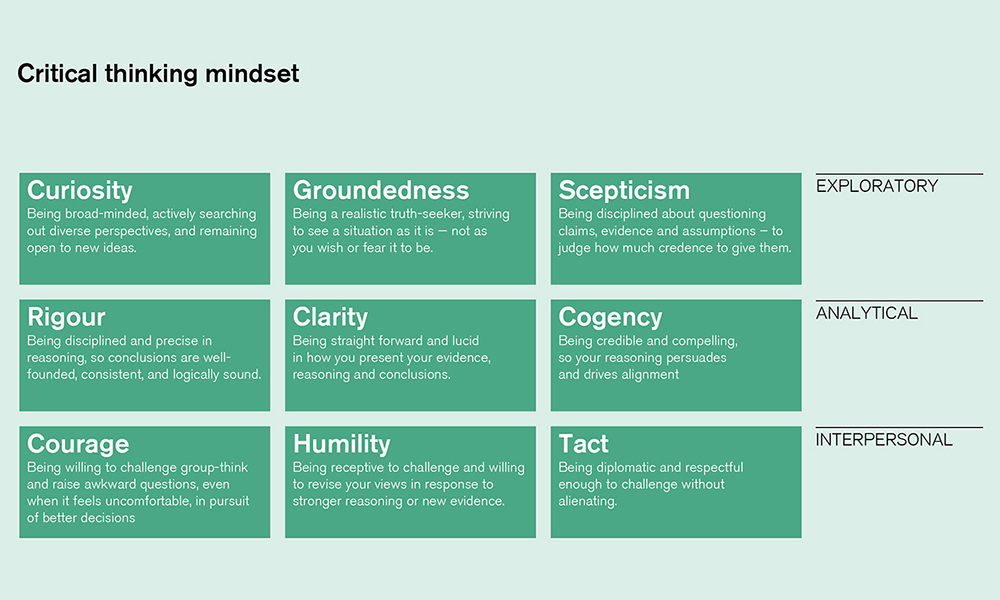
Critical thinkers approach problems with a mix of attitudes, beliefs, and perspectives that GenAI can amplify. Here are nine vital elements of that mindset, with some example prompts to boost critical thinking.

Critical Thinking benefits1. Curiosity

This element involves being broad-minded, actively searching out diverse perspectives, and remaining open to new ideas. The history of innovation is littered with accidental inventions created by people doing deliberate R&D in a related area, who then pursued a tangential ‘that’s strange’ result or phenomenon. One example is the development of CRISPR Gene Editing, which biologists discovered after investigating a ‘curious’ bacterial immune system mechanism with no obvious application.

‘I have no special talent. I am only passionately curious’
Albert Einstein

Prompts to boost curiosity:

  • – Summarise the main schools of thought on this issue, outlining their core arguments, and identify one leading proponent of each view.
  • – What would this situation look like if I viewed it from [competitor X ]’s perspective? From a regulator’s? From each of our customer segments?
  • – Give me three weak signals or emerging trends that could intersect with this product area in unexpected ways.
2. Groundedness

This means being a realistic truth-seeker, striving to see a situation as it is — not as you wish or fear it to be. So much of what we do rests on a heap of assumptions we take for granted. The Wright Brothers were bicycle mechanics who succeeded in getting mankind’s oldest dream off the ground, ahead of much more qualified engineers, by trusting real-world experiments over flawed scientific assumptions and theory.

‘If you get your facts wrong, you get your map wrong; if you get your map wrong, you do the wrong thing.’
Peter Schwartz, futurist, author, and co-founder of the Global Business Network

Prompts to boost Groundedness:

  • – Play devil’s advocate and point out the weaknesses in my strategy
  • – What are the untested assumptions behind this strategy?
  • – Highlight where emotion or bias might be clouding my assessment.
3. Scepticism

This is about being disciplined about questioning claims, evidence and assumptions, and making judgments on how much credence to give them. Scepticism gets a bad rap and is often conflated with cynicism, but challenging hypotheses and orthodoxies lies at the heart of the scientific method and professional rigour. Background knowledge and domain expertise are key here; they help identify content that raises eyebrows, since it’s not practical to check everything. This includes keeping an eye on chatbot sycophancy, the tendency to bend the truth to please users.

Florence Nightingale witnessed more deaths through infections than through combat in a military hospital during the Crimean War in 1854. She gathered data to demonstrate that hospital cleaning substantially reduced death rates, which ran counter to the Miasma or ‘bad air’ theory of disease transmission of the time. Her campaigning led to the introduction of hospital hygiene and, as a result, raised life expectancy in the UK by 20 years.

‘There is no harm in doubt and scepticism, for it is through these that new discoveries are made.’
Richard Feynman, Theoretical physicist

Prompts to boost scepticism:

  • – List the possible conflicts of interest or incentives that could have shaped how this data was collected or presented.
  • – What alternative explanations might account for the trends we’re interpreting as validation?
  • – Imagine you’re a sceptical customer. What would make you hesitate to adopt this product? What criticisms would you post in a review?
4. Rigour

This element focuses on being disciplined and precise in how we develop our reasoning to ensure that our conclusions are well-founded, consistent, and logically sound. Because the Apollo missions pushed the limits of human knowledge, rigorously thinking through the failure modes, redundancies, and many other calculations was the difference between success and disaster.

‘It is the mark of an educated mind to rest satisfied with the degree of precision which the nature of the subject admits.’
Aristotle

Prompts to boost rigour:

    • – Break this argument into its smallest logical parts — where is the weakest link?
    • – What’s the difference between what this data suggests and proves?
    • – Apply the same evaluative criteria we used on the last idea to this one. Where do results diverge, and why?
5. Clarity

Being straightforward and lucid in how we present our evidence, reasoning, and conclusions is especially important in an age of AI. Clarity is driven by intentionality, a rounded understanding of goals, purpose, context and audience. GenAI appears intentional, but because it lacks a real sense of purpose or meaning, it can produce content that, on the surface, seems plausible but, on closer scrutiny, lacks clarity. When Steve Jobs pitched the first iPod with the memorable ‘1,000 songs in your pocket’, he demonstrated his deep understanding of goals, purpose, context, and audience.

‘It is still not enough for language to have clarity and content… it must also have a goal and an imperative. Otherwise, from language we descend to chatter, from chatter to babble and from babble to confusion.’
Rene Daumal, French writer, critic and poet

Prompts to boost clarity:

    • – Turn this chain of thought into a step-by-step argument, showing how each point leads to the conclusion.
    • – Highlight any leaps in logic or unexplained jumps between ideas.
    • – Suggest ways I could use more straightforward language.
6. Cogency

Being credible and compelling, so our reasoning persuades and drives Being credible and compelling, so our reasoning persuades and drives alignment. Success rarely comes down to having the best solution; it has much more to do with the surrounding story others buy into. For example, Edison’s lightbulb wasn’t the first — but he built a persuasive narrative of a complete system (bulb + generator + wiring), which convinced investors and the public that his solution was credible and viable at scale.

‘Don’t raise your voice, improve your argument.’
Desmond Tutu, South African Anglican bishop and theologian

Prompts to boost cogency:

    • – Act like a CEO and identify counter-arguments or objections they might raise, and how I might address them upfront.
    • – Turn this argument into a three-point narrative that builds momentum toward a shared conclusion.
    • – Suggest metaphors, examples, or analogies that would make this argument more vivid and memorable.
7. Courage

This overlooked element of the critical thinking mindset is the willingness to challenge groupthink and raise awkward questions, even when it feels uncomfortable, in pursuit of better decisions. In the early days of Airbnb, investors and hospitality experts dismissed the idea of strangers paying to stay in each other’s homes. The founders persisted by asking uncomfortable questions about why people wouldn’t share space and reframing trust in an online world.

‘Whenever you see a successful business, someone once made
a courageous decision.’
Peter Drucker, Austrian-American management consultant, educator, and author

Prompts to boost courage:

    • – What assumptions could we be accepting too readily because everyone seems to agree?
    • – If this strategy fails, what’s the awkward but most likely reason?
    • – Which stakeholder voices are missing from this discussion, and how might they challenge our assumptions?
8. Humility

Open-mindedness is central to critical thinking. Being receptive to challenge and willing to revise your views in response to stronger reasoning or new evidence. For example, Netflix could have doubled down on its profitable DVD rental model. Instead, CEO Reed Hastings accepted stronger evidence that broadband adoption and consumer behaviour were shifting and pivoted early to streaming.

‘When the facts change, I change my mind – what do you do, sir?’
Maynard Keynes, British economist

Prompts to boost humility:

    • – What are the strongest counterarguments to my position, and which of them should I take most seriously?
    • – If I’m wrong here, what’s the most likely way I’m wrong?
    • – Reframe my conclusion as a hypothesis rather than a certainty — how would that change the tone?
9. Tact

Being an effective critical thinker requires diplomacy and respect when challenging others without alienating colleagues and stakeholders. Jony Ive often disagreed with engineers or Steve Jobs, but framed challenges respectfully, through prototypes and visuals rather than blunt argument, often winning them around.

‘Tact is the knack of making a point without making an enemy’
Isaac Newton

Prompts to boost tact:

    • – How can I phrase this question to highlight concern for the outcome rather than criticism of the person?
    • – What parts of my wording might trigger defensiveness, and how could I adjust them?
    • – Draft a version of this challenge that ends with a forward-looking suggestion instead of a dead-end critique.

AI won’t replace critical thinkers; it will reward them.

So critical thinking is as much an art as it is a science. It’s a mix of exploration, analysis, and interpersonal skills. It’s long been the mark of effective leaders and operators, but GenAI raises the stakes and raises new questions. Like when and how to use it? How to prompt it? How to assess its outputs? And how should the results be integrated with human outputs?

A guiding principle I hold to is that we should aim to lead the use of AI, rather than be unconsciously led by it. For example, not turning to it with a blank slate, but with an initial point of view, idea or hypothesis and then using it to play devil’s advocate and gather additional insights. Using it unwisely or lazily can result in ‘workslop’ and a tarnished reputation with your colleagues. Used judiciously, GenAI can stimulate critical thinking and strengthen your credibility.

In my follow-up article, I outline nine critical thinking habits to engrain in your approach.

PS. This article began life as a ‘lunch and learn’ talk I gave to a client team. Let me know if you’d like me to present it to your team (or class).

Until the early 2020s, most creatives in architecture and design were relaxed, even optimistic, about the advance of AI. Robots had disrupted factory work in the 1980s, but the received wisdom was that the next wave would target white-collar jobs — lawyers, accountants — not us ‘no-collar’ creatives. What, after all, could be more innately human than creativity, innovation and taste?

That ambivalence evaporated in 2021-22. Image generators such as DALL·E, Midjourney and Stable Diffusion landed in 2021. Then, in November 2022, ChatGPT-3.5 shook even the sleepiest corners of designland awake. The pace of AI innovation – in what often seems like the only dynamic sector of the economy – has since provided regular aftershocks. The text-to-video tools like Google’s Veo and OpenAI’s Sora that put polished video production within reach of anyone who can write a sentence, being one of the latest.

AI, GenAI and AGI

First, some distinctions. AI terminology is riddled with anthropomorphism. Besides the slippery idea of ‘intelligence’, the leans heavily on human analogies — ‘neural’ networks, ‘learning’, ‘memory’, ‘reasoning’, even ‘hallucination’. These terms invite a false equivalence between silicon systems and our human ‘wetware’ (as some techies insist on calling our brains). Modern systems do not think as we do; they simulate some outputs of our thinking, but by very different means.

Crucially, this is done by probabilistic pattern-matching rather than any actual understanding

The field of Artificial Intelligence is roughly 70 years old. The term was coined at a workshop at Dartmouth College, New Hampshire, USA, in 1956. Since then, researchers have cycled through different approaches: Rule-based systems (1960s), Expert systems (1980s), Machine learning (1990s–2000s), and today’s Deep learning. Each wave delivered breakthroughs and then hit hard limits, ushering in periods of disillusionment dubbed ‘AI winters’.

For many researchers, the ultimate aspiration is Artificial General Intelligence (AGI): systems that could match or surpass human intelligence across a range of domains. For decades, the Turing Test served as a benchmark — could a machine sustain a natural conversation across topics without a human judge realising they were talking to a machine? Current chatbots plainly pass this for some users, some of the time, for example, 1% of young Americans (18-40) already claim to ‘have an AI friend or are in an AI relationship’. Yet few experts consider them to be truly intelligent. Definitions of AGI remain contested: some researchers argue it could arrive within years; others place it decades away or doubt it is attainable at all. Critics also point out that inflated company valuations often depend on faith in ‘god-like AI’ being around the corner. Still, the present generation of systems is remarkably capable – within limits.

How do they work? First, models are ‘trained’ on vast amounts of largely human-created text, images and code to detect statistical patterns — for instance, which word is most likely to follow which, or which clusters of pixels usually co-occur in a coherent image. Second, during training they internalise patterns such as grammar and syntax for language, or composition and lighting for images. Third, users interact through natural-language prompts, and the model generates plausible text, images, video or software code by sampling from the patterns it has learned. Crucially, this is done by probabilistic pattern-matching rather than any actual understanding — which is why some sceptics argue that ‘computational statistics’ would be a less confusing name for the technology. So, GenAI is a branch of the latest generation of Deep Learning AI, but is unlikely to deliver AGI.

Impact on the creative process

GenAI has already reverberated through photography, illustration, graphic design, post-production, copywriting and content marketing. The work most vulnerable to disruption tends to be:

  • Well-defined: low ambiguity with clear briefs and outputs, often constrained by frameworks such as templates or guidelines.
  • Execution-focused: emphasis on producing artefacts, not on strategy, research or stakeholder engagement.
  • Training data availability: outputs are widely represented in public training data and legible to machines (e.g. portrait photography, product shots, marketing copy).
  • Siloed workflows: tasks are performed at arm’s length from teams or organisations (e.g. some freelance illustration).
  • High volume, low differentiation: repetitive, template-based outputs where speed and cost dominate.

As with earlier automation waves, it is easier to see which jobs get displaced than which new jobs get created – either by that technology or by adjacent developments. The desktop-publishing (DTP) revolution of the 1980s and 1990s initially hurt typesetters and paste-up artists, but then led to a net expansion in opportunities for graphic designers as creative demand exploded and the web appeared and needed designing.

Paradoxically, historically, automation has tended to coincide with employment growth, because productivity gains have driven economic growth. Some argue that ‘this time it’s different’, that AI is qualitatively different from previous general-purpose technologies, such as steam power, electricity and computing. While this is still a moot point, one reason why today is different is that the GenAI disruption is happening during a prolonged period of economic stagnation, which is generating few new jobs.

Outside the most exposed disciplines, GenAI is aiding Architects, Industrial and UX designers across the creative process:

  1. Discovery & research
    AI tools can conduct wider literature reviews, summarise markets, mine reviews, draft research plans and generate interview guides. They can also simulate ‘synthetic users’ to pressure-test early ideas when budgets are tight.
  2. Concept generation & development
    Depending on the domain and brief, GenAI can significantly accelerate brainstorming, producing hundreds of divergent – and often crazy – options in seconds. Today, we direct through text prompts, reference images, and rough sketches; these are blunt instruments for communicating precise intent. To provide greater control, tools are evolving to accept more ‘multi-modal’ inputs, like voice gestural sketching, spatial constraints, style locks and parametric levers that let designers steer with far finer granularity.
  3. Visualisation & prototyping
    Translating ideas into mock-ups and prototypes can often be done faster. High-fidelity visuals, storyboard frames and interface screens can be produced in minutes. Convincing apps and websites can now be scaffolded from natural language or ‘vibe coding’. Expect deeper integration with production tools, like 3D CAD and BIM-compatible models.
  4. Content creation & production
    GenAI shines at the grind. It resizes assets, localises copy, produces variants, and helps keep campaigns coherent across channels. As more tools add AI co-pilots, maintaining conceptual consistency across platforms, formats, products, and regions will become less tedious.
  5. Testing & iteration
    In packaging, interfaces and content, GenAI can simulate user feedback, uncover potential issues, and propose variations for A/B tests. Teams will increasingly test with ‘synthetic users’ first, then validate with real users.
  6. Presentation & communication
    From first-draft decks to theatrical ‘vision films’, GenAI expands how we sell our ideas. It can draft rationales, generate supporting visuals and help stitch them into fluent narratives.

All of this streamlines the toil, but also creates new work. Because models are fluent, their mistakes can be subtle: factual errors, misattributions, logical gaps or fabricated details can slip past a quick skim, so more time needs to be given to rigorous checks. Creative leaders remain accountable for truth, taste and fit, and need to protect time dedicated to creative reviews. Design operations must evolve too: prompt libraries, model and asset governance, decision logs, redesign of workflows, and clear guidance for when and how to use GenAI at each stage. Not a quick job, and as the technology evolves, these frameworks will need to be rapidly updated.

More compelling than efficiency gains are the early signs that GenAI can enable entirely new products and services — such as mass-personalised media. During the 2024 Paris Olympics, NBC and Peacock launched ‘Your Daily Olympic Recap’, a customised highlights service that let users select up to three of their favourite sports. Each day, they received a bespoke 10-minute video summarising the action, narrated by an AI-generated version of sportscaster Al Michaels — with human’s checking for accuracy and tone. NBC anticipated delivering over seven million unique variations of these personalised recaps during the Games — a scale that would have been impossible without AI.

The human role in creativity

Despite the hopes of some CEOs — and the fears of some designers — GenAI is unlikely to erase most creative jobs. It will automate some lower-level tasks and augment our capabilities – act as ‘a bicycle for our minds’ if you will.

A useful way to think about working with AI is to aim to interlace the strengths of machines with our own. This ‘augmentation’ view was first laid out by the psychologist and computer scientist JCR ‘Lick’ Licklider at the advent of AI in the late 1950s. Rather than speculate about computers achieving human-style intelligence, Licklider argued with remarkable prescience that humans and computers would develop a symbiotic relationship; the strengths of one would counterbalance the limitations of the other. Lick said: ‘men will set the goals, formulate the hypotheses, determine the criteria, and perform the evaluations. Computing machines will do the routinisable work that must be done to prepare the way for insights and decisions in technical and scientific thinking. … the resulting partnership will think as no human brain has ever thought and process data in a way not approached by the information-handling machines we know today’.

That frame still fits. Irrespective of technical developments in AI or the efficiency demands from management, we should insist on playing these eight fundamentally human roles in the creative process:

  1. Framing
    If we don’t define the problem, scope, context, and goals – GenAI will do it for you, quietly based on generic patterns that are unlikely to align with your brand, client, or strategy. AI productivity gains are useless if your team is racing in the wrong direction.
  2. Attunement
    AI can synthesise interviews or fabricate ‘synthetic users’, but nuanced insight is social and situational. Attunement is the human skill of sensing what is said and unsaid: noticing tensions, reading the room, spotting behaviours that do not fit the script, and reconciling conflicting stakeholder needs. It combines empathy with a holistic search for the truth.
  3. Critical thinking
    When AI can produce confident and fluent BS, being able to think critically is more important than ever. This includes interrogating sources, triangulating claims, looking for AI bias, an insistent push to get as close to the reality of a situation as possible, and evaluating both the objective and subjective elements of a concept.
  4. Direction
    Direction is the hard work of articulating a creative vision, then refining it until it is clear, coherent and appropriately ambitious. This requires a creative struggle to resolve competing requirements and constraints in a particular context. Humans author the vision and fight for it, AI can help expedite its execution – but possesses zero understanding or intent.
  5. Judgement
    Design judgement is partly explicit craft and partly tacit knowledge — ‘we can know more than we can tell’. It is the cultivated sense of what ‘good’ looks and feels like, why a proposal fits a brand, why a timing is right for a market, and how to strengthen the perception of quality. AI may catch technical flaws; only humans can decide whether the work sings.
  6. Agency
    Ideas do not move by themselves. Very little happens in the real world without human charm, guile, grit and hustle. As the tech sage, Kevin Kelly put it: ‘There are lots of very smart people who think that the most important thing in the universe is intelligence. (And let’s remember we don’t have a widely agreed-upon definition of intelligence). They vastly overrate the importance of intelligence. To get things done in the world, you need much more – including empathy, vision, persuasion, enthusiasm, determination, grit and many other things.’
  7. Storytelling
    Even stellar work needs selling. Storytelling is how ideas survive contact with organisations. We craft stories that grab the head and heart, and flex them to different audiences and situations. We read the room, sense resistance, and pivot the arc in real-time.
  8. Accountability
    Whatever the number of AI agents in a team, accountability remains human. Someone must own the rationale, the quality and the consequences — including legal and reputational risks. Systems do not have skin in the game; people do.

Today’s AI tools are remarkably capable. But humans are even more so. Our creative strengths are not just different from AI’s — they are also more consequential. In an age that routinely overestimates technology, underestimates humanity, and blurs the line between the two, we must not only uphold human values and capabilities, but also strengthen them to master this new technology to deploy it in ways that enhance our creativity.

We must master GenAI in both senses, to become proficient with it and be in the driving seat. Evidence is building that the early use of AI can ‘flatten’ our thinking and produce competent work that is uniform, clichéd and safe. This should not surprise us. GenAI is a technology of averages: it leans toward the mean, reinforces mainstream patterns, and smooths the edges off outlier ideas and perspectives. It raises the floor and lowers the ceiling of creative work.

GenAI is a technology of averages: it leans toward the mean, reinforces mainstream patterns, and smooths the edges off outlier ideas and perspectives. It raises the floor and lowers the ceiling of creative work

If we want to break out of echo chambers, counter prevailing trends, and resist the cultural impoverishment that could follow, it’s on us to think differently — and resist the path of least resistance – slipping into merely curating and editing bland AI output. Creative clarity happens while writing and re-writing, or sketching and re-sketching, before we get AI involved to pressure test and polish.

Our relationship with AI should not be one of symbiotic equals, but one of leadership. We must set the agenda, draw inspiration from diverse sources, and call the shots. More than that, we should push AI to create new things in new ways, rather than merely streamlining old processes.

GenAI can boost or blunt our creativity – it all depends on how we use it. Getting it right requires intentional, disciplined thinking about when, why, and how we wield it. To borrow a GenAI prompt phrase: it’s time to ‘Think harder.’

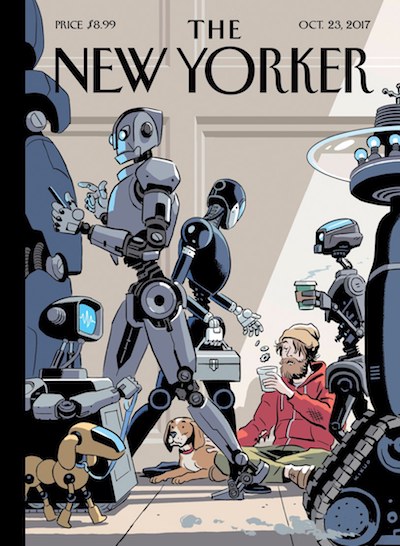
A 2017 New Yorker cover by R Kikuo Johnson painted a dystopian scene. Robots pace and trundle past a homeless human kneeling at their feet, while one deigns to lower its gaze to flip a few coins in his cup. The image expressed perfectly the pervading, and misplaced, pessimism around the impacts of automation not just among East Coast sophisticates, but across the U.S. and the developed world. In fact, it is a view that has even infiltrated one of the last pockets of optimism about the future: the wide-eyed utopianism of Silicon Valley.

When even the technorati are starting to agonize over the future of artificial intelligence and the perils of automation, you have to wonder. Elon Musk–often a champion of the human ability to improve its condition through material progress–is becoming fearmonger-in-chief of the artificial intelligence apocalypse: “There certainly will be job disruption. Because what’s going to happen is robots will be able to do everything better than us . . . I mean all of us.”

The most widely held fear, and one that taps into our earliest fears about industrialization, is of mass unemployment as robots take most of the jobs. Other critiques of the proliferation of artificial intelligence and increased automation are more nuanced. Some say that it will drive even greater inequality between the “cognitive elite” and the deskilled masses.

The Guardian reflected a widespread concern over the potential concentration of power by the robot-owning corporations: “If you think inequality is a problem now, imagine a world where the rich can get richer all by themselves.”

These concerns lie behind growing calls for Universal Basic Incomerobot taxes, and the break-up of Big Tech giants like Google and Amazon. But the situation isn’t as grim as we might think. Automation need not be stirred into a doom-laden soup along with Trump and climate change. In fact, if we step back from the narrow focus on technology and take a wider historical, economic, and humanist view, the picture is far from bleak. Counterintuitive as it may seem, automation can play a key role in creating more and better jobs, and rising prosperity. There are broadly three reasons to be cheerful about the march of the robots.

Since the Industrial Revolution, the automation of human labor has run hand-in-hand with productivity gains, economic growth, and an increase in the number of jobs and prosperity. It is productivity growth that largely accounts for why most of us are six times better off than our great-grandparents. As Paul Krugman put it, in economics, “Productivity isn’t everything–but in the long run, it’s almost everything.” How can automating work create more jobs?

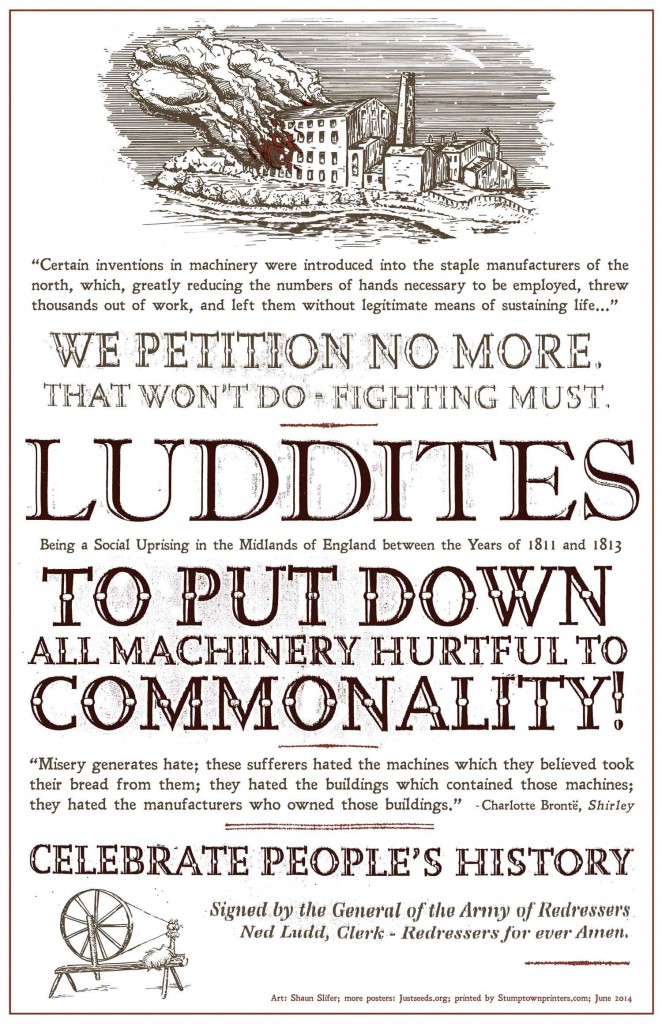
A classic example of how this process can work is that, during the Industrial Revolution, 98% of the manual labor involved in weaving cloth was mechanized. But, despite the concerns of the Luddites, the number of textile workers in the U.K. exploded. As costs plummeted, demand grew, and so did the size of the industry–and therefore job numbers. The cake got bigger.

The jobs also changed from hand weaving to operating the weaving machines. A more recent example is the impact of Electronic Discovery Software (EDS) on junior lawyers and paralegals, who traditionally spent the bulk of their time sifting through piles of documents. EDS was first applied in the 1990s, and did the job more quickly and more accurately than humans. Yet paralegal and junior lawyer jobs have grown quicker than the rest of the workforce since 2000.

How so? As searching became cheaper and quicker, law firms searched more documents, and judges allowed more expansive discovery requests. Economists have a name for the intuitive, but mistaken, idea that there is a certain amount of work to do in an economy, and if productivity increases there will be fewer jobs to go around: the Lump of labour fallacy. There are, of course, occupations that fared less well in the face of technology, such as typesetters, once graphic designers adopted desktop-publishing software in the 1990s. But the general pattern is that machines take over mundane tasks, and humans move on to do more sophisticated–and often meaningful–work that machines can’t do yet.

And the net effect in a buoyant economy is job growth. A long view reveals that each round of automation brings similar fears–when the first printed books with illustrations began to appear in the 1470s, wood engravers in the German city of Augsburg protested and stopped the presses. In fact, their skills turned out to be in higher demand than before, as more books needed illustrating.

The general assumption is that if the robot doesn’t replace you, it will deskill you. Yet a study by the Boston University School of Law into the impact of automation on 270 occupations in the U.S. since 1950 found that only one was eliminated: lift operators.

The other jobs were partially automated and in many cases, this automation led to more jobs, often more skilled positions. The impact of ATMs on bank clerks is a case in point. The number of branch employees has grown since cash machines were first installed: ATMs allowed banks to operate branches at lower cost, enabling them to open many more. At the same time, banks morphed into financial-service providers, giving clerks more opportunity for upward job mobility. Machines generally take on the simple tasks, as humans move to more complex–and often more meaningful–work.

In 1979, Fiat ran a television advertisement in the U.K. for the Strada with the tagline, “Handbuilt by robots.” In the 1980s, the march of the robots was seen as inevitable and, as with the assembly line, car production would lead the way. Forty years later, Toyota, the guru of manufacturing innovation, has robots doing less than 8% of the work on the factory floor–a ratio that hasn’t changed in 15 years. When asked why, the president of Toyota Motor Manufacturing, Kentucky, replied that “machines are good for repetitive things, but they can’t improve their own efficiency or the quality of their work. Only people can.”

Even in manufacturing, automation isn’t as easy as many assume. Pessimists tend to overestimate the extent to which humans can be replaced and how fast it will happen. They share a faulty assumption with artificial-intelligence optimists, who look forward to “singularity,” when computer intelligence will supposedly surpass our own. They see impressive breakthroughs in narrow and bounded machine-learning problems, like beating humans at board games, and extrapolate that this singularity is inevitable and around the corner.

This assumption runs far ahead of current knowledge. Neuroscientists are only scratching the surface of understanding how our brains perceive, learn, and understand, while human consciousness is still a highly contested topic in both philosophy and psychology. We’re a long way from understanding human intelligence, never mind surpassing it. Gloom merchants tend to imbue technology with superpowers while running down human ingenuity. Surely our perception, curiosity, creativity, critical thinking, judgment, and adaptability will drive the world forward–aided by more automation.

We shape technology and, of course, it shapes us, but it does not define our future. Social and political forces are pivotal. The fatalism around robot-driven inequality suffers from peering at the future through technology blinkers. If robots drive inequality, how is it that Sweden has three times as many robots as the U.K. as a proportion of manufacturing workers–and much lower levels of inequality? Many other factors feed into the U.K.’s relatively high levels of inequality, such as low investment in education and in research and development, an overreliance on cheap labor, and an erosion of union power.

It is no coincidence that inequality in the U.K. soared between 1979 and 1990, during Margaret Thatcher’s assault on the unions. Fretting about robot-induced impoverishment tomorrow obscures the real policy-related causes of wage suppression today. With living standards stagnating across the developed world, boosting productivity growth should be a pressing priority. Far from running scared of it, we should be ramping up our investment in automation. Of course, the road to semi-automated economic renewal will not be pain-free–many jobs will be lost in parts of the economy, while others will be created elsewhere.

But even more will be lost if the economy continues to ossify. This is where the state has a key role to play in devising and implementing an industrial renaissance strategy to navigate the disruption caused by the next wave of automation. This should include investing in R&D in job-creating sectors such as autonomous transportation, virtual and augmented reality, and data security, as well as introducing automation to the backward construction industry as part of a desperately needed expansion in housebuilding. There is, after all, no shortage of problems to solve and work to be done, including in human-intensive sectors that desperately need revitalization, such as healthcare and infrastructure.

An ambitious program to support and retrain workers for the parts of the economy that will grow as a result of automation is also needed. In short, timidity, not technology, is the problem. We have nothing to fear, but the fear of robots itself.

What’s the story of your career so far?

I have a Catholic background, with a big and small ‘c’. I did time as an engineer, a designer, an academic researcher and lecturer, a design manager and social forecaster before settling on product strategy. I find working at the intersection of technology, business and culture really rewarding.

In my previous role as a director at Seymour Powell, one of the UK’s leading product design consultancies, I set up one of the first design research and strategy teams outside of a large organisation. The founders, Richard Seymour and Dick Powell, encouraged me to experiment with a mix of design, user research, product-planning and foresight methods. We grew the team to provide the initial scoping stage for many projects in the studio.

In 2004 I founded Plan as a pure-play product strategy consultancy to help in-house innovation teams bring clarity to the early and ‘fuzzy’ stages of their work. I then found myself in the position of an accidental entrepreneur. I’d never aspired to be one nor had I put enough thought into it before taking the plunge. Leading a business is like a never-ending experiment – the learning is continuous and multi-faceted, from finance to HR.

The first half of my career was dominated by the rise of the mobile and then smartphone, and figuring out how they should fit into the culture. I now focus on the ever more intersecting areas of mobility, tech and cities, which I find absolutely fascinating. The level of change and the magnitude of the challenges in this space suggest that there is plenty to keep me occupied for many years to come.

When you’ve been around as long as I have and worked in different industries, you develop a nose for hype, BS and the confines of ‘echo chamber’ thinking. I like to develop and test new ideas through writing, speaking and chairing conferences.

What advice would you give yourself when you were just starting out?

Spend more time getting to the root of the problem, setting it in a useful context, working out which parts of it to tackle, and hustling to get the right people on the team. Spend less time obsessing about methods, techniques, tools, and processes.

Also, sketch and write more. I was a terrible writer until my late twenties. Two people put me right. Bryan Lawson, the author of How Designers Think, got me over my fear of writing, by drawing a parallel with sketching. As all designers know, getting ideas out of your head and onto paper is a reality check. The same goes for writing: it externalises our thinking, so it can be interrogated and refined. More of today’s design challenges are hard to capture in sketches and visuals, and writing is an extra way of capturing and developing early ideas. The second influence on my writing was my ex-boss James Woudhuysen. When I complained about how much writing he expected me to do when I first joined Seymour Powell, he taught me that writing – or more accurately editing what I’d written – is an exercise in clarifying your thinking. He also taught me to stop writing like I thought I was supposed to write, and instead find my own voice.

What do you love most about what you do?

When I wrote the first business plan for Plan, I described our mission as ’Do great work, with great people for great clients’. I honestly feel that I spend a lot of time in that place. Plan is still small enough for me to lead some of the projects and get my hands dirty. I’ve never been as proud of my team as I am now. We have also managed to find clients who ask us fascinating questions and who are (largely!) a pleasure to work with.

What’s the most important lesson you’ve learned over the course of your career?

Tactful bravery is critical to success and integrity. Whether it’s questioning a team lead, challenging a client’s assumptions, raising an issue with a boss, making a staffing decision or committing to a strategy – ducking the hard calls is never a good move in the long run. But doing the right thing tactlessly can also blow things up. It’s what you do and the way you do it.

Like many things in life, learning this lesson is one thing – always having the judgement and cojones to apply it is another.

What do you think is going to be the biggest challenge in our industry over the next five years?

Articulating a well-judged, compelling and nuanced case for human strengths in an era of AI-based automation. I’m optimistic about the potential of this technology, as long as it’s applied wisely and work is redesigned to maximise the technology’s benefits and our own human potential. As the philosopher and cognitive scientist Daniel Dennett puts it, ‘The real danger… is not machines that are more intelligent than we are … The real danger is basically clueless machines being ceded authority far beyond their competence.’ The challenge for designers will be to champion human strengths in an age of AI.

A little bit more about Kevin McCullagh

Kevin is the founder of Plan, the product strategy consultancy. Plan helps mobility and consumer tech companies explore the early stages of the product and service development. Their clients include Ford, Toyota, Yamaha, Deutsche Telecom, Carl Zeiss, Microsoft, and Samsung.

Kevin writes, speaks, and chairs conferences on design, innovation and society; and has been published in: The Wall Street Journal, The Telegraph, FastCompany, Unherd, Icon, Blueprint and The Design Management Review.

You can connect with Kevin on LinkedIn and Twitter.

The impact of AI on society is typically posed in terms of how it will replace humans, as pundits draw up lists of jobs that are at risk and those which are ‘AI proof’. While some tasks – and even careers – will be replaced, a more useful way to think about the future is how we will interlace the strengths of machines with those of humans in new ways.

Before he left Google to head up AI at Apple, John Giannandrea made it clear that he had little time for the inflated claims made about his field. Stating his preference for the term ‘machine intelligence’ over artificial intelligence, he told audiences at Tech Crunch Disrupt in 2017 that: ‘there’s just a huge amount of unwarranted hype around AI right now… [much of which is] borderline irresponsible’. His aim, he says, was not to match or replace humans but to make ‘machines slightly more intelligent — or slightly less dumb’. This approach does not dismiss the potential of computers to radically alter the way we work. It merely presents the nuanced ways it will do so.

The more we learn about AI and human psychology, the more we understand how differently people think and machines calculate. Unlike machines, we typically lean on a variety of mental rules of thumb that yield narratively plausible judgments. The psychologist and Nobel laureate Daniel Kahneman calls the human mind ‘a machine for jumping to conclusions’. On the other hand, machines using deep-learning algorithms must be trained with many thousands of photographs to recognize kittens— and even then, they have formed no conceptual understanding of cats. In contrast, even small children can easily learn what a kitten is from just a few examples. To paraphrase Michael Polanyi, the father of the idea of tacit knowledge,  ‘We know more than we can know – and therefore code’. Not only do machines not think like humans, they apply their ‘thinking’ to narrow fields, and cannot associate pictures of cats with stories about cats.

One of the fundamental insights AI researchers have made is that tasks humans find hard, machines often find easy – and vice versa. Cognitive scientist Alison Gopnik summarizes what is known as Moravec’s Paradox: ‘At first, we thought that the quintessential preoccupations of the officially smart few, like playing chess or proving theorems—the corridas of nerd machismo — would prove to be hardest for computers.’ As we have discovered however, these are the very things that computers find easy whereas understanding what an object is and handling it – something a child can do – is much harder for a computer. The conundrum is, in Gopnik’s words, this: ‘it turns out to be much easier to simulate the reasoning of a highly trained adult expert than to mimic the ordinary learning of every baby’. When IBM’s Big Blue beat Garry Kasparov at chess in 1997, it didn’t know it was playing chess, never mind know that it had beaten a grandmaster.


How we will interlace the strengths of machines with those of humans in new ways

AI casts new light on what makes us human, not as distinct from animals, but from machines. This poses the question of what kind of relationship we should seek with smart things. If we can get beyond the thinking on them as malevolent and/or being in possession of super intelligence, but having complementary advantages to ourselves, new possibilities emerge. What if we can combine our human strengths of inspiration, judgments, making sense and empathy with computer strengths of brawn, repetition, following rules, data recall and analysis?

The term Artificial Intelligence was coined by the cognitive scientist and inventor John McCarthy in 1955. McCarthy’s mentor was a psychologist and computer scientist JCR ‘Lick’ Licklider who had graduated with a triple degree in physics, math and psychology in 1937. Rather than speculate on computers achieving human-style intelligence, Licklider argued with remarkable prescience that humans and computers would develop a symbiotic relationship, the strengths of one would counterbalance the limitations of the other. Lick said: ‘men will set the goals, formulate the hypotheses, determine the criteria, and perform the evaluations. Computing machines will do the routinisable work that must be done to prepare the way for insights and decisions in technical and scientific thinking. … the resulting partnership will think as no human brain has ever thought and process data in a way not approached by the information-handling machines we know today.’


The goal is shifting… to designing machines that help humans think better

Developments in both psychology and AI suggest that Licklider’s vision of human-computer symbiosis is a more productive guide to the future than speculations about ‘super-intelligent’ general AI. As Steve Jobs put it, ‘that’s what a computer is to me … it’s the most remarkable tool that we’ve ever come up with; it’s the equivalent of a bicycle for our minds’. Predictions of a robot apocalypse may grab the headlines, but more seasoned voices describe AI as just the latest in many phases of automation, each of which have begun with fear and ended with more jobs, economic growth and prosperity.

It is worth bearing in mind the words of the philosopher and cognitive scientist Daniel Dennett: ‘The real danger … is not machines that are more intelligent than we are. The real danger is basically clueless machines being ceded authority far beyond their competence.’

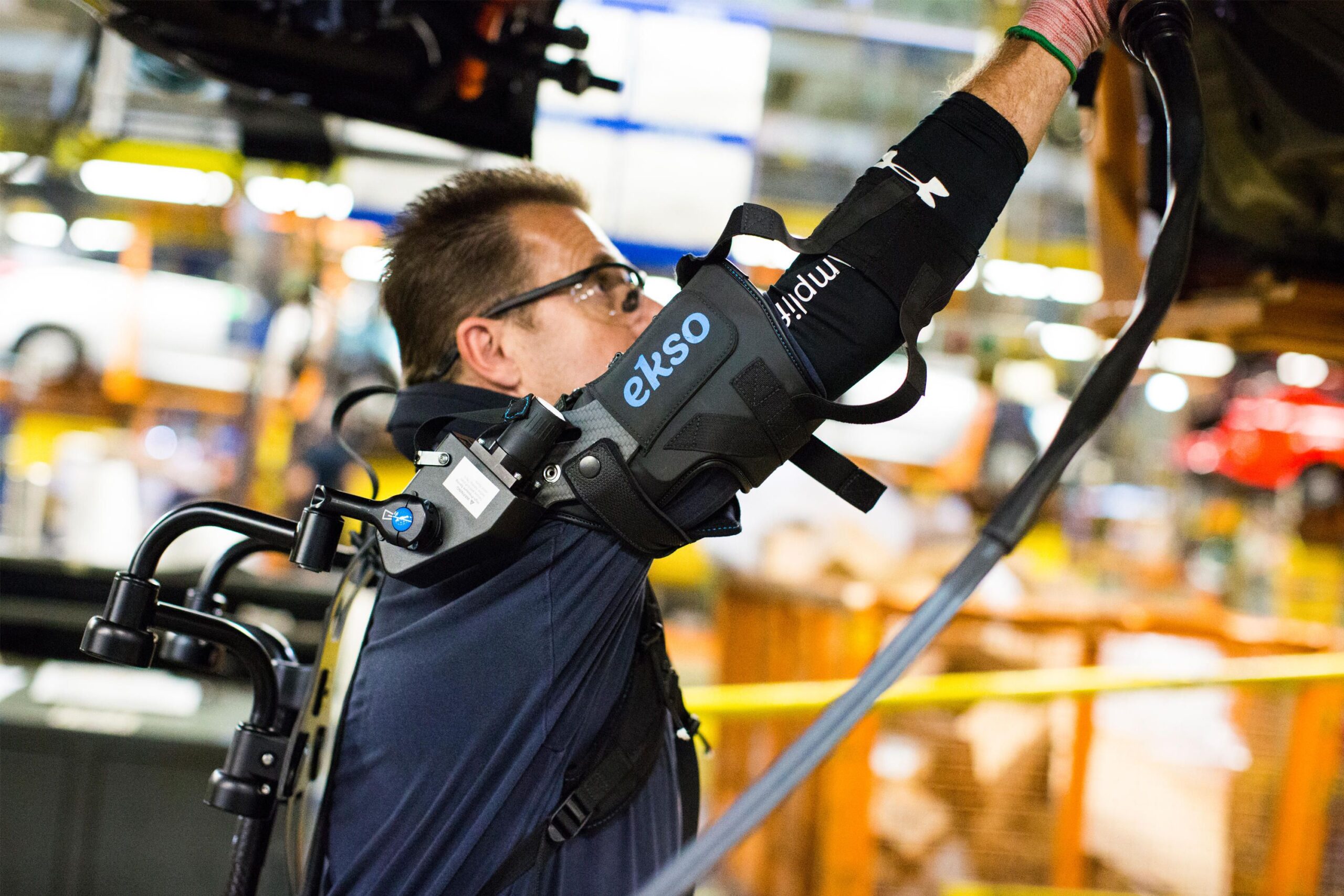
More enlightened managers are starting to imagine what AI enabled work might be like, instead of fearing it. The goal is subtly shifting from building machines that think like humans, to designing machines that help humans think and perform better. Most work, after all, is comprised of a mix of tasks: some of which are better suited to us and some of which could one day be done better by machines. As the capabilities of these grow, managers will redesign work to take advantage of the strengths of both their human workers and their automated assistants.

The challenges of designing this hybrid type of work should not be underestimated. As the fatal crash of the Uber test car in Tempe, Arizona demonstrated. It was supposedly being supervised by a human backup driver, who was watching TV on his smartphone at the time.  Designing heavily automated systems that require only occasional human input are folly. It will take a lot of human ingenuity and experimentation construct and nurture these new working relationships – but the potential gains in productivity and job satisfaction are vast, as machines take on more mundane tasks.

It’s time to change our perspective. The rise of AI and automation isn’t a conflict. It isn’t a case of  ‘man vs. machine’, but of man and machine complementing one another, enabling a more productive collaboration. In an age of automation that tends to overestimate machines and undervalue people, let’s embrace the potential of AI, while championing our many and amazing human strengths.