‘Skate to where the puck is going to be, not to where it’s been,’ this Wayne Gretzky quote was one of Steve Jobs’ favourites. It underlined his focus on ‘the next big thing’ as a window of opportunity to pounce on, think the iPod or music streaming.
The future can’t be predicted, but foresight work helps you make sense of change, reduce shocks and shorten your odds on big bets
While I like its future orientation and focus on identifying the next consequential shift, the puck metaphor never worked that well for me. Pucks travel in straight lines, but the future happens in fits, starts, and handbrake turns. ‘There are decades where nothing happens, and there are weeks where decades happen’, as Lenin is reported to have noted. A historical insight that feels particularly prescient for anyone planning major initiatives in today’s environment. How will the rise of economic nationalism impact our supply chain? How will AI shape our future products and services – and talent profile? How will tech-savvy and proactive Boomers shake up longstanding assumptions about ageing?
The future can’t be predicted, but foresight work helps you make sense of change, reduce shocks and shorten your odds on big bets.
Innovators prefer to use foresight to anticipate to initiate. We don’t analyse trends as passive observers, but as active agents with designs on making a dent in the future. The bigger the bet, the bigger the need. The longer the time horizon. The bigger the investment. The higher the potential for market disruption. The more reckless it is to wing it.. For example, automotive or train hardware initiatives can have time horizons of over a decade, and in aviation, multiple decades. The investments involved are huge, as are the levels of uncertainty.
A client recently asked me to summarise my approach to foresight work, which tends to focus on consumer tech, healthcare and mobility initiatives. I boiled it down to these 10 tenets.
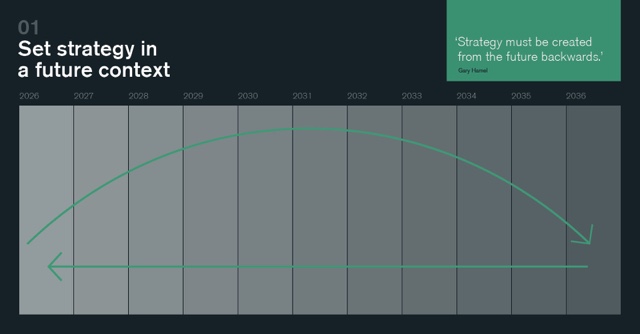
‘Strategy must be created from the future backwards,’ as Gary Hamel, the management guru, pithily put it. Building an informed set of assumptions about the future enables executives to envision and plan for a landscape that does not yet exist. Once you’ve outlined a future state, you have something to plan against. This approach counters a natural continuity bias, assuming it will be an incremental improvement on today, which is akin to driving into the future by looking in the rear-view mirror.
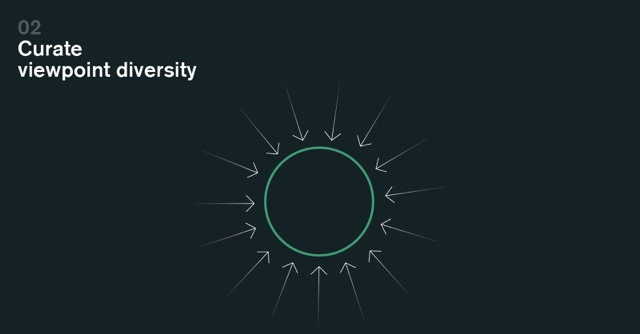
Too much foresight work suffers from wishful thinking. To help avoid projecting our hopes (and fears) onto the future, it’s best to find ways to distance ourselves from our unconscious biases. A good way to do this is to ensure your team holds differing viewpoints so that assumptions can be better explored and interrogated. A useful complement to this approach is to add some external domain experts to the mix, boosting thought-leading viewpoint diversity and credibility.
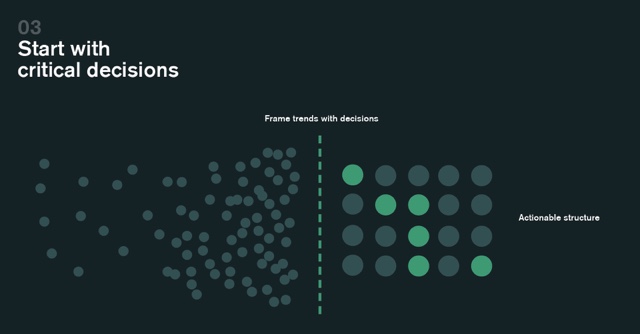
The future is a big place, and there are hundreds of shifts to choose from. To avoid foresight theatre amid a mix of generic trends and hot topics, it’s wise to ground futures work in the strategic choices the business is pretty sure it’ll have to make. These decisions form trend-selection criteria to ensure you focus on the pertinent rather than the flavour-of-the-month buzz topics. You should still be open to uncovering some wildcard trends, but being decision-focused ensures your efforts will be actionable.
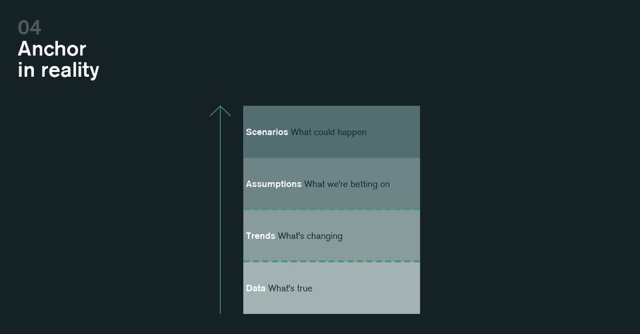
Foresight work inevitably leans into what is changing and can quickly untether itself from reality. To prevent ‘futures intoxication’, ground the work in recent economic, technological and cultural facts to ground it on baseline truths. Reflecting on the tricky job of predicting the rate of change, the futurist Roy Amara cautioned that ‘We tend to overestimate the effect of a technology in the short run and underestimate the effect in the long run.’
Back in 2016, like many others, I was initially swept up in the Autonomous Vehicle hype. This was the year when the CEO of Lyft, an Uber competitor, claimed that most Lyft rides would be in driverless taxis by 2022. That didn’t happen, but 10 years on, in 2026, robocabs are a daily reality in some Chinese and US cities, with US-based Waymo recently announcing it’s now operating 0.5m rides a week across 10 cities.
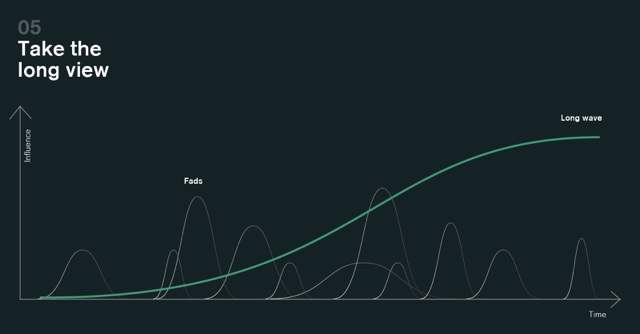
An overemphasis on shiny new bandwagons blights futures work. How much time and resources were burned on the patently woolly notion of the Metaverse? Key decisions are just as likely to be influenced by the evolution of long-established trends as the latest fad setting the podcasts alight. It can often be more insightful and actionable to really understand the recent developments of a long-established trend that is pertinent to your strategic choices, rather than get distracted by the mania of the moment.
In the depths of Covid lockdowns and after a few years of Flygskam (flight shame) appearing in trend decks, I pointed out in a talk that air travel continued to rise after 9/11 and the financial crisis, and would likely do the same post-pandemic. Global passenger traffic surpassed pre-pandemic volumes in 2024 – and is set to double by 2045. It pays to pull up to gain the wider 35,000-ft perspective. To paraphrase Hans Rosling, bad news comes quickly, good news happens slowly.

Once is an accident, twice is a coincidence, and three times is a trend is a well-worn business proverb. Foresight demands more than pattern recognition and description. To understand what’s really driving change, you have to examine how trends develop — their interactions with drivers and inhibitors. Narrowing down to a manageable number of pertinent trends gives you more time to analyse the underlying forces beneath them – both their drivers and their counter-drivers. Digging beneath surface appearances to identify and assess the balance of forces helps you reach firmer judgments on likely trajectories and impacts.
It was only when I dug deeper into the CASE (Connected, Autonomous, Shared and Electric) vision of the future of mobility across numerous projects that so many economic, infrastructural, technological, social, environmental and ergonomic speed bumps surfaced.
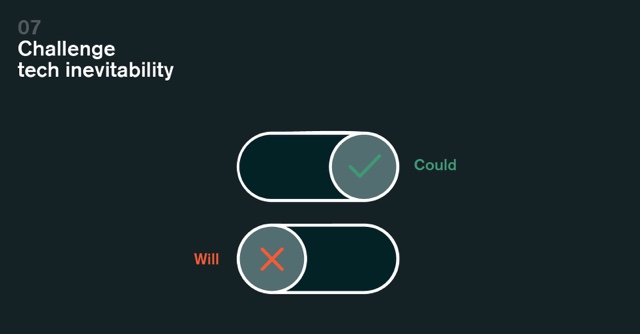
One of the most common errors—especially in tech companies—is viewing the future through the lens of the tech hype, assuming (often implicitly) that tech is the primary driver of change. This blinkered view had us living through the Atomic Age, Space Age, Supersonic Age, Information Age, and now the Age of AI. It’s an easy trap: the belief is widely held and loudly trumpeted, plus technology is simpler and more tangible than the messier and more abstract social, cultural, economic, and legislative forces at play.
Technology is not destiny. Many hyped trends never materialise—remember 3D TV or the Hydrogen cars? And, even when they do, they are shaped by other forces. Social, cultural and political shifts often prove more decisive. Few futurists in the 1970s and 1980s anticipated the sweeping rise of women in the workplace and wider society in the decades that followed. Also, consumers are not passive recipients of innovation; they shape it to their own ends. Consider today’s pushback against EVs and heat pumps.
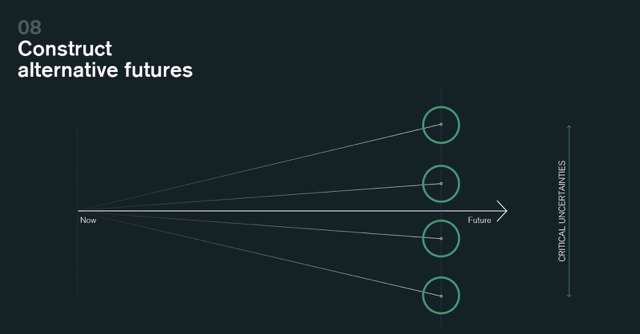
The future cannot be predicted; so don’t sweat crafting perfect predictions. Instead, generate a range of potential futures plotted along dimensions of the main uncertainties you have identified. Building, discussing, and assessing these alternative future worlds challenge assumptions, expand options, and improve judgment. You are not aiming for any one scenario to be a prescient prediction. The future usually includes elements from multiple scenarios, and different customer segments can end up in separate ones. Then assess your hypotheses, decisions or concepts against each scenario to check their robustness across alternative futures.
You’ll overlook some developments, but the very act of working through different scenarios will raise your game. As Dwight D. Eisenhower, WWII general and U.S. president, reflected ‘In preparing for battle I have always found that plans are useless, but planning is indispensable.’
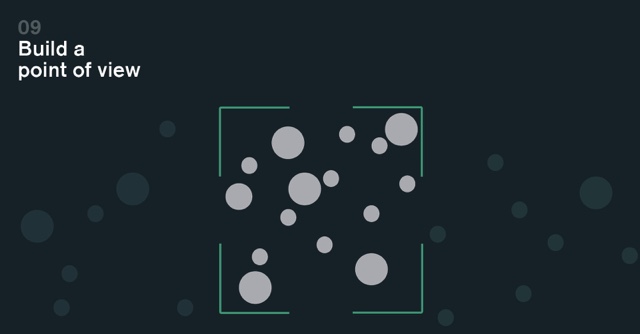
Foresight is not a science; it’s a convincing perspective on future opportunities and risks. To make it strategic, you need to combine far-sightedness with shrewd thinking about the implications and opportunities for your organisation. The same future can affect different companies in very different ways, so your plan should be tailored to your context.
Ultimately, your foresight assumptions will be educated guesses and judgment calls. There’s no data on the future, so it’s down to you to build a credible, coherent, compelling and commercial case for your planning decisions. Credibility comes from facts and expert opinion — the ammunition behind your bold claims. Your story needs to cohere; if the pieces don’t reinforce each other, sceptical executives will find the gaps. Being compelling means reaching beyond logic to your audience’s instincts and ambitions. And being commercial? That’s the part most foresight work skips: articulating how your view of the future translates into competitive advantage and growth.
Since your point of view will be based on facts, if those facts change, your opinions might need to be updated. As the futurist, Paul Saffo sagely put it: ‘hold strong opinions weakly…If you must forecast, then forecast often and be the first to prove yourself wrong.’
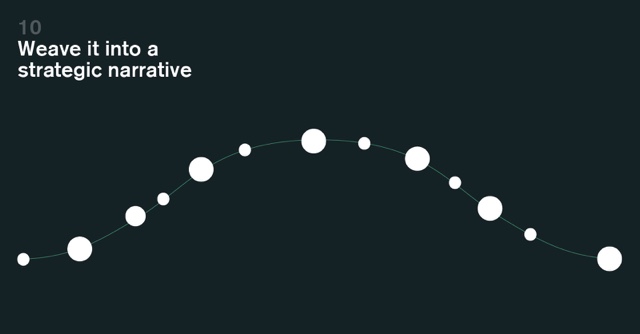
Bullet points rarely build buy-in. To convince, tell an engaging story that pulls together all the pertinent threads from disparate sources into a singular thread. This narrative will require more than the core strategy; it will also need some scene-setting to explain why they should care, some killer examples or metaphors to bring your story to life, and some preemptive strikes against anticipated counterarguments. Outline what’s changing, what you’re pretty confident will happen and what the critical uncertainties are. Identify the opportunities and risks of alternative future scenarios. Then, land what it all means for your organisation, your plan, and how it will capitalise on the opportunities and mitigate the risks. If time and budget allow, visualise implications and opportunities to make the future tangible. Finally, polish, practice, and pitch it with pizazz.
Strong foresight isn’t the product of a process; it’s more dependent on experience, domain knowledge, and worldly judgement, but I’ve found these 10 principles to be a useful guide and checklist. If you’re looking to raise your leadership team’s foresight game or to stress-test and build alignment around a longer-term initiative, particularly for teams navigating long-horizon bets in mobility, consumer tech or healthcare, I give a limited number of talks a year on building foresight into long-term strategy (no follow-up pitches).
Critical thinking isn’t a personality type. It’s also more than a mindset. First and foremost, it’s a disciplined set of habits. To paraphrase James Clear, the author of Atomic Habits, we do not rise to the level of our goals; we fall to the level of our habits. So, it’s not enough to believe in critical thinking; we have to train it like a muscle – it strengthens through disciplined reps. Over time, these routines become second nature, giving our thinking the resilience to hold up under the pressure and pace of daily life.
My last post outlined the critical-thinking mindset in an age of AI. This one outlines nine habits to help embed that frame of mind into your daily routines.
1. Read, listen and watch widely
Critical thinking is not a free-floating technique; it’s a proactive engagement with facts, information and opinions. Critical thinkers don’t just passively consume their ‘filter bubble’ feed — they select a range of perspectives that stretch and refine their understanding. A broad information diet helps them spot patterns, contextualise evidence, and know exactly where to probe and what to ask.
They actively seek out clever people and opinions, including those they disagree with. Comfortable with their assumptions being tested, not coddled, they are open to sharpening their opinion in the face of new information or a more compelling argument. They see changing their mind as growth and progress, rather than a sign of weakness.
Discomfort is data — pay attention to it.
2. Adapt to the specific context
Sound decisions start with seeing the situation clearly and framing the context around the subject at hand, which determines what kind of thinking the moment needs. Critical thinking isn’t a fixed routine; it flexes to the circumstances. Good thinkers read the room, the stakes and the constraints. They know that every decision sits in a web of agendas, incentives, timelines and imperfect data.
Product teams make hundreds of calls a day. Most don’t need forensic analysis. The real skill is recognising which decisions deserve slow thinking. In his book, Build, Tony Fadell draws a helpful distinction between two types of decision: data-driven decisions, which can be tested with evidence, and opinion-driven decisions, which rely on debate and judgment when data is scarce. Both need critical thinking — but not the same kind. One leans on analytical rigour; the other on challenge and counter-argument.
Critical thinkers match their approach to the moment.
3. Surface your assumptions
Assumptions are the hidden scaffolding of our thinking — the beliefs we treat as obvious that don’t need checking. Making them explicit gives us and our colleagues something to test, challenge and improve.
Every domain has its favourite fictions — here are a few classics from the past:
- ‘If we build it, they will come’
- ‘Touch screens will never be good enough to type quickly on’
- ‘We own the customer, so they’ll use our app store’
- ‘Our brand perception won’t be a barrier to moving upmarket’
- ‘Customer service chatbots won’t impact brand loyalty’
- ‘Younger users don’t care about privacy’
When assumptions lie hidden, they become silent drivers of flawed thinking. We slip into false certainty and mistake belief for fact. Groupthink thrives as premises go undiscussed. And when plans rest on wishful thinking, organisations become strategically blind.
The antidote is simple: surface the assumptions. Log them. Run pre-mortems. Ask ‘What must be true for this to work?’. Expose your assumptions before they expose you.
4. Write it out
Writing, like sketching, is a great way of getting thoughts out of your head and into the world, where they can be more clearly assessed. Just like we clarify design concepts through sketching and re-sketching, we refine more abstract concepts through writing and re-writing. The act of putting words down forces meaning to surface. Writing is thinking in slow motion — it exposes gaps, sharpens intent and turns intuition into reasoning.
Strong thinkers have always known this:
- ‘If you’re thinking without writing, you only think you’re thinking’, Leslie Lamport
- ‘I write entirely to find out what I’m thinking. What I’m looking at, what I see and what it means.’, Joan Didion
- ‘Ideas that are flaky appear even more so when committed to paper. Conversely, ideas that are inherently strong get even stronger through the discipline of writing, ’ Gary Hamel
- ‘I write because I realised at art school that you can only draw a small percentage of the attributes of an object. If I were to draw a glass, you would understand only 20 per cent of its nature. You would have no sense of its weight, or material, or temperature. You would have no sense of how it reacted to its environment. Writing helps me frame the problem. A lot of mistakes are made when you frame a problem, because you could already be dismissing 60 per cent of the potential ideas.’, Jony Ive
The same logic applies to GenAI. Prompting is writing: the clarity of your input shapes the quality of the output. Loaded questions, hidden assumptions and sloppy framing produce biased or vague responses. And editing GenAI text is non-negotiable. AI has no understanding, judgment or intent — which means you are accountable for the meaning, accuracy and tone of anything you ship.
AI accelerates drafting; writing preserves judgment.
5. Embrace nuance
In polarised and distracted times, the path of least resistance is to let our thinking be framed by headlines and social media hot takes. These perspectives tend towards black-and-white thinking that flattens complex issues into neat binaries. Good vs bad, success vs failure, quality vs speed — these oppositions make conversations easier but decisions worse.
Critical thinkers distrust such Manichean simplicity. The truth and wise choices usually lie in grey areas of trade-offs between competing priorities and coexisting perspectives. Rarely is it a question of either-or; it’s almost always a subtle combination of both.
Teenagers argue in black and white; grown-ups work in gradients.
6. Make discerning distinctions
Working in gradients does not imply blurring the lines between them. Drawing useful contrasts lies at the heart of clear thinking. It sharpens understanding by separating things that look similar but work differently. Useful is the operative word — because distinctions that don’t clarify can quickly slip into pedantry. Making distinctions isn’t about splitting hairs; it’s about revealing structure and adding precision. When we make discerning distinctions, we see relationships more clearly and create the conditions for better conversations, sounder judgments, and richer alignment.
Critical thinkers clarify confusion and reveal insight, for example, by distinguishing between needs and wants, between simplicity and usability, and between customisation and personalisation.
The right lines don’t divide thinking — they focus it.
7. Steelman counter-arguments
When faced with opposing views, engage with their strongest version. This is the opposite of the strawman tactic, where we attack a flimsy caricature of someone’s argument — the kind they’d never actually make.
Steel-manning takes generosity and discipline. Restate the opposing case as clearly and persuasively as possible — sometimes better than its originator. Then test and refine your position against it.
This approach doesn’t just sharpen reasoning; it builds credibility and trust. People are far more likely to listen when they feel heard and accurately represented. And if your argument still holds after you’ve strengthened the opposing one, it will stand on firmer ground.
Sharpen your sword on the hardest stone.
8. Make time for quality checks
One impact of GenAI is that it shifts where we focus our attention. Used wisely, it can streamline research, idea generation and visualisation, among other tasks. But working with AI creates work elsewhere. Managers are still accountable for their team’s output, yet quality-checking GenAI requires a different approach.
When chatbots can nail tone, structure and grammar, surface polish stops being a reliable quality signal, but AI doesn’t ‘know’ things; it predicts plausible text, pixels and code.
Here are three quality checks to run on GenAI content:
1. Traps, not typos: AI can appear convincing but be wrong, precise but invented, confident but unfounded. Scrutinise any fact, stat or claim you’d be embarrassed to defend in a meeting.
2. Logic, not just the conclusion: AI often sounds persuasive at first blush, but on a slower second reading, it can lose the plot. Break the answer into steps and check whether each one actually supports the next. If you can’t restate the argument clearly in your own words, you don’t really have one – even if you like the conclusion.
3. Alignment, not just correctness: AI feigns awareness of your context, culture and content, but it actually understands none of it. It often subtly changes the question or blurs your intent. Check for hidden drift: does this response still answer your question, for your vision and setting?
Domain knowledge really matters here. The more you understand the space, the easier it is to smell when something is off – no matter how slick the output looks.
GenAI shifts the effort from creation to verification. Critical thinkers own the sign-off.
9. Think for yourself, but not by yourself
Good thinking starts alone — noticing your own biases, checking your assumptions, spotting where you might be fooling yourself. But it gets much sharper through conversation. Critical thinkers invite good-faith challenges to their reasoning, evidence and interpretations. They don’t fear pushback; they rely on it.
Ed Catmull, co-founder of Pixar, advises managers to ‘put smart, passionate people in a room together, charge them with identifying and solving problems, and encourage them to be candid with one another.’ Teams that normalise respectful, constructive challenges raise the collective quality of their work — and surface blind spots no one could see alone.
The real power of these habits lies in how they spread. When teams share a language, reward good questions, and normalise reflection, critical thinking becomes a collective reflex — not a personal virtue.
You can’t control the noise, the pace or the algorithms — but you can control your habits. And the right habits keep judgment grounded and sharp. Clarity isn’t a gift – it’s a practice.
PS. This article began life as a ‘lunch and learn’ talk I gave to a client team. Let me know if you’d like me to present it to your team (or class). Sample slides here.
In an age shaped by algorithmic overload, echo chambers and plummeting trust in traditional sources of authority, critical thinking is the new literacy. It is fast becoming essential for citizenship, work, and life in the age of AI.
We have known its value since the ancients, of course, when Aristotle counselled, ‘Be a free thinker and don’t accept everything you hear as truth. Be critical and evaluate what you believe in.’
critical thinking is the new literacy. It is fast becoming essential for citizenship, work, and life in the age of AI
It’s always been wise to be discerning about how we assess and marshal assumptions, opinions, data, facts and ideas – but now we need to add Generative AI (GenAI) content to the mix. In a recent article, I argued that Critical Thinking is one of eight fundamentally human roles in the creative process and should not be delegated to AI.
On the surface, GenAI outputs text, code and imagery which look like other information we’re familiar with, but it demands different questions, such as:
- What do we know about the data the AI models were trained on?
- What do we know about the models’ biases and limitations?
- What was the prompt that generated the content?
- OK, it’s polished, fluent and plausible – but how faithful is it to reality or the truth?
Critical fundamentals
Before we get into how to use GenAI in a discerning way, let’s start with some fundamentals.
Critical thinkers:
- Seek clarity, accuracy and precision – not muddle through
- Ask incisive questions – rather than take things as given
- Evaluate evidence rigorously – instead of trusting instinct over insight
- Stay open-minded – rather than dig in dogmatically
- Work systematically – not sloppily
- Look for nuance – rather than falling into black and white thinking
- Strive for coherence – rather than gloss over contradictions
- Build in reflection — instead of following the same playbook out of habit
The perils of uncritical thinking are legion. They include: falling for marketing hype, mindlessly following groupthink, colleagues not getting a fair hearing, getting the wool pulled over your eyes, dogmatism, incoherent arguments and presentations, building strategies based on wishful thinking and being blindsided by overlooked developments.
 These are core rewards of critical thinking; the next step is cultivating the attitudes that sustain them.
Critical mindset
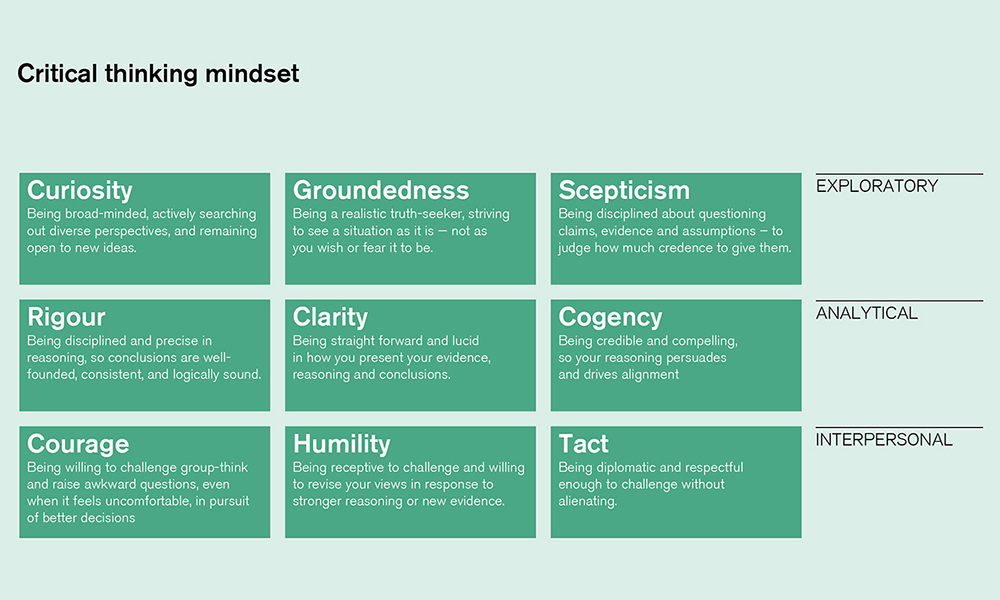
Critical thinkers approach problems with a mix of attitudes, beliefs, and perspectives that GenAI can amplify. Here are nine vital elements of that mindset, with some example prompts to boost critical thinking.
 1. Curiosity
This element involves being broad-minded, actively searching out diverse perspectives, and remaining open to new ideas. The history of innovation is littered with accidental inventions created by people doing deliberate R&D in a related area, who then pursued a tangential ‘that’s strange’ result or phenomenon. One example is the development of CRISPR Gene Editing, which biologists discovered after investigating a ‘curious’ bacterial immune system mechanism with no obvious application.
‘I have no special talent. I am only passionately curious’
Albert Einstein
Prompts to boost curiosity:
- – Summarise the main schools of thought on this issue, outlining their core arguments, and identify one leading proponent of each view.
- – What would this situation look like if I viewed it from [competitor X ]’s perspective? From a regulator’s? From each of our customer segments?
- – Give me three weak signals or emerging trends that could intersect with this product area in unexpected ways.
2. Groundedness
This means being a realistic truth-seeker, striving to see a situation as it is — not as you wish or fear it to be. So much of what we do rests on a heap of assumptions we take for granted. The Wright Brothers were bicycle mechanics who succeeded in getting mankind’s oldest dream off the ground, ahead of much more qualified engineers, by trusting real-world experiments over flawed scientific assumptions and theory.
‘If you get your facts wrong, you get your map wrong; if you get your map wrong, you do the wrong thing.’
Peter Schwartz, futurist, author, and co-founder of the Global Business Network
Prompts to boost Groundedness:
- – Play devil’s advocate and point out the weaknesses in my strategy
- – What are the untested assumptions behind this strategy?
- – Highlight where emotion or bias might be clouding my assessment.
3. Scepticism
This is about being disciplined about questioning claims, evidence and assumptions, and making judgments on how much credence to give them. Scepticism gets a bad rap and is often conflated with cynicism, but challenging hypotheses and orthodoxies lies at the heart of the scientific method and professional rigour. Background knowledge and domain expertise are key here; they help identify content that raises eyebrows, since it’s not practical to check everything. This includes keeping an eye on chatbot sycophancy, the tendency to bend the truth to please users.
Florence Nightingale witnessed more deaths through infections than through combat in a military hospital during the Crimean War in 1854. She gathered data to demonstrate that hospital cleaning substantially reduced death rates, which ran counter to the Miasma or ‘bad air’ theory of disease transmission of the time. Her campaigning led to the introduction of hospital hygiene and, as a result, raised life expectancy in the UK by 20 years.
‘There is no harm in doubt and scepticism, for it is through these that new discoveries are made.’
Richard Feynman, Theoretical physicist
Prompts to boost scepticism:
- – List the possible conflicts of interest or incentives that could have shaped how this data was collected or presented.
- – What alternative explanations might account for the trends we’re interpreting as validation?
- – Imagine you’re a sceptical customer. What would make you hesitate to adopt this product? What criticisms would you post in a review?
4. Rigour
This element focuses on being disciplined and precise in how we develop our reasoning to ensure that our conclusions are well-founded, consistent, and logically sound. Because the Apollo missions pushed the limits of human knowledge, rigorously thinking through the failure modes, redundancies, and many other calculations was the difference between success and disaster.
‘It is the mark of an educated mind to rest satisfied with the degree of precision which the nature of the subject admits.’
Aristotle
Prompts to boost rigour:
-
- – Break this argument into its smallest logical parts — where is the weakest link?
- – What’s the difference between what this data suggests and proves?
- – Apply the same evaluative criteria we used on the last idea to this one. Where do results diverge, and why?
5. Clarity
Being straightforward and lucid in how we present our evidence, reasoning, and conclusions is especially important in an age of AI. Clarity is driven by intentionality, a rounded understanding of goals, purpose, context and audience. GenAI appears intentional, but because it lacks a real sense of purpose or meaning, it can produce content that, on the surface, seems plausible but, on closer scrutiny, lacks clarity. When Steve Jobs pitched the first iPod with the memorable ‘1,000 songs in your pocket’, he demonstrated his deep understanding of goals, purpose, context, and audience.
‘It is still not enough for language to have clarity and content… it must also have a goal and an imperative. Otherwise, from language we descend to chatter, from chatter to babble and from babble to confusion.’
Rene Daumal, French writer, critic and poet
Prompts to boost clarity:
-
- – Turn this chain of thought into a step-by-step argument, showing how each point leads to the conclusion.
- – Highlight any leaps in logic or unexplained jumps between ideas.
- – Suggest ways I could use more straightforward language.
6. Cogency
Being credible and compelling, so our reasoning persuades and drives Being credible and compelling, so our reasoning persuades and drives alignment. Success rarely comes down to having the best solution; it has much more to do with the surrounding story others buy into. For example, Edison’s lightbulb wasn’t the first — but he built a persuasive narrative of a complete system (bulb + generator + wiring), which convinced investors and the public that his solution was credible and viable at scale.
‘Don’t raise your voice, improve your argument.’
Desmond Tutu, South African Anglican bishop and theologian
Prompts to boost cogency:
-
- – Act like a CEO and identify counter-arguments or objections they might raise, and how I might address them upfront.
- – Turn this argument into a three-point narrative that builds momentum toward a shared conclusion.
- – Suggest metaphors, examples, or analogies that would make this argument more vivid and memorable.
7. Courage
This overlooked element of the critical thinking mindset is the willingness to challenge groupthink and raise awkward questions, even when it feels uncomfortable, in pursuit of better decisions. In the early days of Airbnb, investors and hospitality experts dismissed the idea of strangers paying to stay in each other’s homes. The founders persisted by asking uncomfortable questions about why people wouldn’t share space and reframing trust in an online world.
‘Whenever you see a successful business, someone once made
a courageous decision.’
Peter Drucker, Austrian-American management consultant, educator, and author
Prompts to boost courage:
-
- – What assumptions could we be accepting too readily because everyone seems to agree?
- – If this strategy fails, what’s the awkward but most likely reason?
- – Which stakeholder voices are missing from this discussion, and how might they challenge our assumptions?
8. Humility
Open-mindedness is central to critical thinking. Being receptive to challenge and willing to revise your views in response to stronger reasoning or new evidence. For example, Netflix could have doubled down on its profitable DVD rental model. Instead, CEO Reed Hastings accepted stronger evidence that broadband adoption and consumer behaviour were shifting and pivoted early to streaming.
‘When the facts change, I change my mind – what do you do, sir?’
Maynard Keynes, British economist
Prompts to boost humility:
-
- – What are the strongest counterarguments to my position, and which of them should I take most seriously?
- – If I’m wrong here, what’s the most likely way I’m wrong?
- – Reframe my conclusion as a hypothesis rather than a certainty — how would that change the tone?
9. Tact
Being an effective critical thinker requires diplomacy and respect when challenging others without alienating colleagues and stakeholders. Jony Ive often disagreed with engineers or Steve Jobs, but framed challenges respectfully, through prototypes and visuals rather than blunt argument, often winning them around.
‘Tact is the knack of making a point without making an enemy’
Isaac Newton
Prompts to boost tact:
-
- – How can I phrase this question to highlight concern for the outcome rather than criticism of the person?
- – What parts of my wording might trigger defensiveness, and how could I adjust them?
- – Draft a version of this challenge that ends with a forward-looking suggestion instead of a dead-end critique.
AI won’t replace critical thinkers; it will reward them.
So critical thinking is as much an art as it is a science. It’s a mix of exploration, analysis, and interpersonal skills. It’s long been the mark of effective leaders and operators, but GenAI raises the stakes and raises new questions. Like when and how to use it? How to prompt it? How to assess its outputs? And how should the results be integrated with human outputs?
A guiding principle I hold to is that we should aim to lead the use of AI, rather than be unconsciously led by it. For example, not turning to it with a blank slate, but with an initial point of view, idea or hypothesis and then using it to play devil’s advocate and gather additional insights. Using it unwisely or lazily can result in ‘workslop’ and a tarnished reputation with your colleagues. Used judiciously, GenAI can stimulate critical thinking and strengthen your credibility.
In my follow-up article, I outline nine critical thinking habits to engrain in your approach.
PS. This article began life as a ‘lunch and learn’ talk I gave to a client team. Let me know if you’d like me to present it to your team (or class).