Not for everyone
Design thinkers are right that there is a more strategic role for designers – but only for some designers. For those with the potential and drive to step up, traditional design skills only gets them so far. To raise their game, they must acquire new know-how.
Design is not important
Design thinking offered “designing for nondesigners.” Let us be clear: Purposefully shaping our environment is what separates humanity from baboons—everyone can design. Exceptional design is what matters, and is much harder. To quote Jonathan Ive: “Design is not important. Good design is important.”
Process is not enough
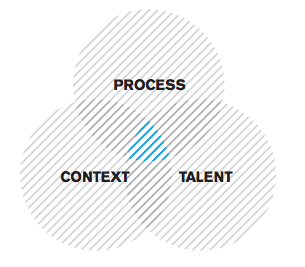
Unwisely, design thinking sold a simple and snappy version of the product design process as a magic method that could be applied universally. In reality, process is nothing unless it begins within the right context (for example, with problem definition and vision) and with the right design talent.
Five capabilities to build on
Cross-silo communication
Working at the intersection of marketing and R&D, designers can play the role of translators or bridges between departments. Being able to talk people and technology enables them to facilitate effective cross-functional dialogue. This ability could be strengthened by learning the language of finance and supply chains.
Experience awareness
Many designers are good at grasping the subtleties of consumer perceptions and behaviors. Whether through observational research or more intuitive cultural interpretation, they situate and solve problems in a cultural context. As products and services become more complex, the ability to focus on experiences across touch-points is more highly valued.
Foresight and vision
Creating the future is part of every designer’s job description. While others seek data, designers spot ways to make tomorrow easier and more enjoyable than today. Fascinated by change, they excel at imagining future scenarios, anticipating new needs, and envisioning potential solutions. As businesses drown in data, clear-sighted vision is sorely needed.
Visualisation and prototyping
Making ideas tangible by sketching and prototyping is one of designers’ most obvious skills. As design solutions become more multifaceted, this ability will become more highly prized, but new techniques will need to be mastered—from infographics to Arduino prototyping.
Resolving and completing
One of designers’ most underrated abilities is pulling tangible stuff together for deadlines. While the alpha IQs wrestle with complexity and analysis paralysis, designers inch the ball forward by offering tangible solutions—in time for the key project review. Design strategists build on this discipline by producing objects of synthesis beyond design visuals.
Capabilities to brush up on
Macro-micro perspective
Situating problems within a big-picture context is a strategic fundamental. Design strategists earn their coin by adopting this helicopter view and zooming down to the fine details of the experience. This helps senior management engage with design effectively. It’s also the hardest capability to acquire, because it requires a sustained acquisition of contextual knowledge.
Analytical rigor
Designers are often criticised for their over-reliance on intuition and for their lack of any grasp of reality. [5] Analytical techniques and tools are relatively easy to pick up, but practice is required to wield them effectively. Rigor is a habit of mind that is developed through levels of systematic interrogation of data that are higher than usual in design. Analytical rigor fused with intuitive leaps is a rare and potent mix.
Opportunity framing
Strategic challenges tend to be fuzzy, multidimensional, and often wide in scope. Designers are not taught how to define opportunities in ways that are credible in a business context. Framing essentially consists of distilling a complex set of issues down to a few critical variables. These are then used to frame problem definitions, hypotheses, and points of view.
Guidance frameworks
There’s much truth in the maxim “Strategy is easy, execution is hard.” A sound strategy is a precursor to success, but no guarantee—quality of execution is critical. Strategists appreciate the craft and compromises of design, while finding ways to help designers focus on the ultimate objectives—by developing clear decision-making principles and tools.
Reasoning and communication
Strategies have a tendency to bounce off organisations, unless they are presented with impact and “socialised” through tailored one-to-one communication. To persuade, messages should be honed to be clear, concise, and cogent. Make them appeal to the head through sound rationale, and to the heart through well-chosen examples, metaphors, and stories.
As design thinking becomes associated with dilettantes and the backlash mounts, it’s worth drawing a distinction between its overblown claims and the real inroads some designers have made into more strategic roles.