The class of 2026 graduates into a flatlining economy with AI taking off. It appears unprecedented, and many feel somewhere between disquiet and despair. I’m here to strike some notes of optimism.
The same things that got me through then are the things that will get you through now.
I graduated into a recession. 1991: unemployment heading for 10%, inflation a 10%, a Gulf war and an oil shock thrown in for good measure. Sound familiar? There weren’t many jobs going, even with a good degree, so I juggled three part-time gigs for a couple of years before a career took shape. Two friends, who went on to become Design directors, spent a year or two on building sites before they got their’s going.
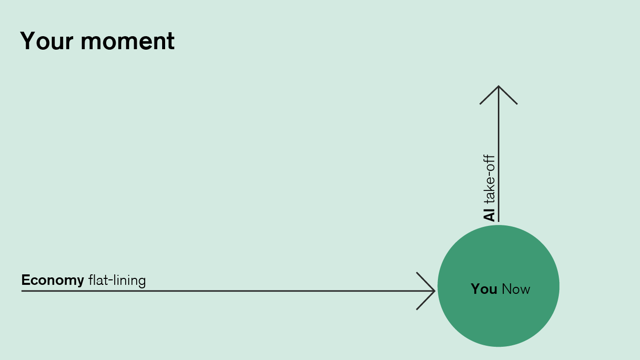
History doesn’t repeat itself, but it often rhymes. Back in 1991, there was a disruptive new technology on every designer’s lips — 3D CAD. There would be no need for sketching, physical modelling, or testing. It would transform design.
Here is the encouraging part. 3D CAD did lead to changes, along with many other developments, such as Experience Design, Business Design, ‘Lean Start-up’, and Designing with Data – but the core role of the designer evolved and, in many ways, became more rewarding.
The same things that got me through then are the things that will get you through now. I’ve boiled them down to three: lean into being a designer, lean into being high-agency, and lean into new and messy problems.
1. Lean into being a designer
Your sketching, CAD and research skills matter — but they don’t set you apart from non-designers, and AI is learning to do a lot of this. What sets you apart is your ability to solve problems in cultural and commercial contexts. Don’t define yourself by tools that come and go.
Four fundamentals hold their value because non-design colleagues often aren’t good at them, and they are the hardest to automate.
Framing. Most projects begin in a fog of ambiguity, with a vague brief that someone has to sharpen into something usable. AI thrives on well-posed problems; it is far weaker at loose briefs. Naming the real challenge — and imposing the constraints that bring it into focus — is becoming more valuable, not less. (More on this here →)
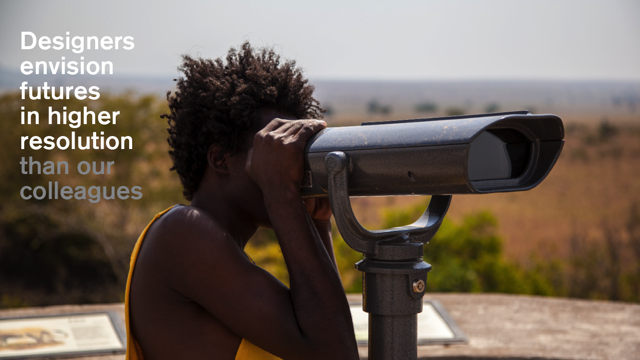
Vision. Designers can see the potential of future products and experiences in higher resolution than their colleagues. If a team has no north star, every decision downstream gets harder. Helping your team have something concrete to aim for, where designers can play a more strategic role.
Taste and judgement. When AI can spin up a hundred concepts on demand, increasingly prompted by a marketer, product manager or an engineer — knowing which ones to develop – and why – becomes a vital skill. We know what good looks like, and more importantly, how to make it happen. We also know when work fits the brand and the target market. But you have to earn that judgement out loud, with a clear rationale, rich vocabulary and strong opinions. ‘Trust me, I’m the designer’ won’t cut it. (Eight creative roles AI shouldn’t play →)
Craftsmanship. Tools change; the commitment to quality of execution shouldn’t. Anyone can spot quality. Designers know how to hone the details that deliver it — the ones that elevate and pull a fragmented experience into a coherent whole.
2. Lean into being high-agency
This is the one that matters most. Ideas don’t move by themselves. Very little happens in the real world without human zeal, charm, grit and hustle. Agency is simply the capacity to shape your own circumstances: less waiting, more doing; less hoping, more moving; less spectator, more player.
It is also where the AI doom-mongers get it wrong. As Kevin Kelly — who has watched many technologies come and go — argues, the smartest people in tech ‘vastly overrate the importance of intelligence. Getting things done in the world takes empathy, persuasion, enthusiasm, determination and grit’. Machines don’t have those. You do.
Four ways to grow agency:
Care about something. Decide on what you want to be known for. Drill into it. Talk about it. Find others who share your obsession. Do projects on it. Give talks about it. This isn’t quite ‘find your passion’, it is more about testing whether the industry cares about it as much as you do.
Get out there. Most opportunities won’t arrive through LinkedIn. They come through someone you helped two years ago, who now runs a team. Build your network slowly, in person where you can, and give before you receive without keeping score. Learn to tell stories that travel, because even your best work needs selling.
Think for yourself. AI produces plausible nonsense; teams slide into groupthink. The world needs people who can spot both. Interrogate, triangulate, debate and sharpen the team’s rationale — and when you’re not sure, prototype, test and learn. Think for yourself, not by yourself. (More on this here →)
Show up and own it. Unglamorous, but decisive. Turn up on time. Make the tea. Work the angles and be tactfully tenacious. When you get knocked back — and you will — dust yourself down and bounce back. When something breaks, take responsibility and help fix it.
When you get a job, work from the office as much as you can, especially in your first few years. That’s where you learn by osmosis, pick up drive-by feedback, watch professionals up close, and get known.
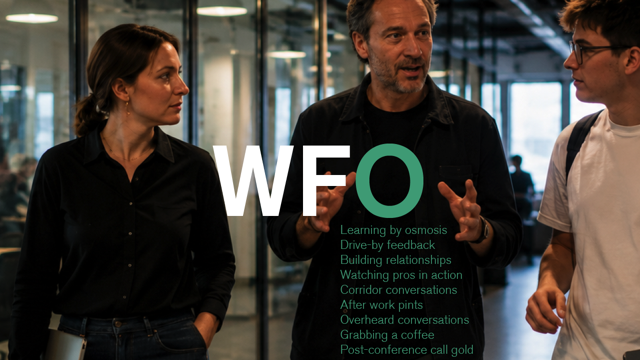
And there is now hard evidence behind that advice. A 2026 LSE study, The Broken Ladder, examined hiring across the UK, US, Canada and Australia and found that the collapse in entry-level recruitment is more closely correlated with remote-work roles than with those exposed to AI. In fact, the AI effect largely disappears once WFH is accounted for. Why? The researchers argue that WFH raises the cost of supervising juniors and slows on-the-job learning. Work from the office to accelerate your learning and get known. (More on the perils of WFH here →)
The collapse in entry-level recruitment is more closely correlated with remote-work roles than with those exposed to AI..
3. Lean into new and messy problems
AI sails through well-posed tasks — it aces maths and law exams and writes a tidy essay. But most real-world work is far messier than exam questions. Messy jobs have moving briefs, no clear scoreboard, people to negotiate with in real time, an unspoken sense of what ‘good’ looks like, and facts you have to go and dig up yourself. That is precisely where humans still hold the edge.
So lean towards the messy and away from the tidy. Be wary of work that is narrowly defined, execution-only, easily templated, done in a silo, or churned out at high volume — that’s the work most exposed to automation. Lean instead into the ambiguous, strategic and collaborative.
It helps to focus on growth areas: AI tooling, physical AI and robotics, the energy pivot, healthcare and ageing, defence and resilience, frontier mobility, and modular construction. AI will pervade all of this and create new jobs as well as displace others. New fields tend to have more openings and fewer veterans, so the playing field is flatter for someone just starting out.
Underpinning all of it are three meta-skills worth cultivating above the rest: keeping your head up, so you’re scanning for what’s next rather than just what’s in front of you; learning how to learn quickly; and connecting the dots between different fields.

You’ve got this
One last story. A recent graduate I know spent his final year worried about his prospects. Rather than stew, he started a podcast interviewing design leaders, built a remarkable network in the process, and walked into a job he wanted after choosing among offers. His own theory of luck is to be ‘exothermic’ — to radiate energy, ambition and kindness, because it’s magnetic and people want to work with you. Get as close as you can to the people you admire; proximity is how you absorb things. And build a sandpit — a website, a Figma file, anything — to show how you actually think.
Much of the work you’ll go on to do hasn’t been invented yet, which means there are no veterans — only people willing to lean in.
You’ve got this. I wish you all the very best with whatever you lean into.
PS — This piece distils a talk I gave to this year’s graduating designers at Nottingham Trent University. The full deck is here. If you run a final-year or graduating course and think your students would get something from it, I’d be glad to give the talk — just get in touch.