‘Skate to where the puck is going to be, not to where it’s been,’ this Wayne Gretzky quote was one of Steve Jobs’ favourites. It underlined his focus on ‘the next big thing’ as a window of opportunity to pounce on, think the iPod or music streaming.
The future can’t be predicted, but foresight work helps you make sense of change, reduce shocks and shorten your odds on big bets
While I like its future orientation and focus on identifying the next consequential shift, the puck metaphor never worked that well for me. Pucks travel in straight lines, but the future happens in fits, starts, and handbrake turns. ‘There are decades where nothing happens, and there are weeks where decades happen’, as Lenin is reported to have noted. A historical insight that feels particularly prescient for anyone planning major initiatives in today’s environment. How will the rise of economic nationalism impact our supply chain? How will AI shape our future products and services – and talent profile? How will tech-savvy and proactive Boomers shake up longstanding assumptions about ageing?
The future can’t be predicted, but foresight work helps you make sense of change, reduce shocks and shorten your odds on big bets.
Innovators prefer to use foresight to anticipate to initiate. We don’t analyse trends as passive observers, but as active agents with designs on making a dent in the future. The bigger the bet, the bigger the need. The longer the time horizon. The bigger the investment. The higher the potential for market disruption. The more reckless it is to wing it.. For example, automotive or train hardware initiatives can have time horizons of over a decade, and in aviation, multiple decades. The investments involved are huge, as are the levels of uncertainty.
A client recently asked me to summarise my approach to foresight work, which tends to focus on consumer tech, healthcare and mobility initiatives. I boiled it down to these 10 tenets.
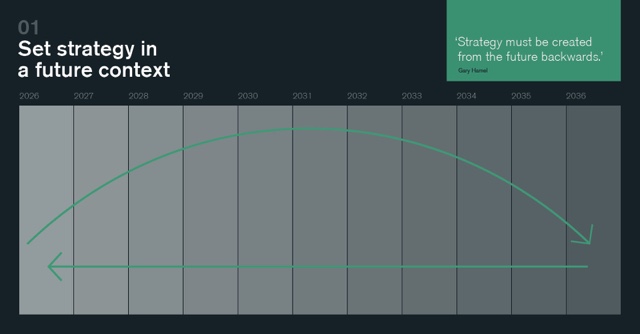
‘Strategy must be created from the future backwards,’ as Gary Hamel, the management guru, pithily put it. Building an informed set of assumptions about the future enables executives to envision and plan for a landscape that does not yet exist. Once you’ve outlined a future state, you have something to plan against. This approach counters a natural continuity bias, assuming it will be an incremental improvement on today, which is akin to driving into the future by looking in the rear-view mirror.
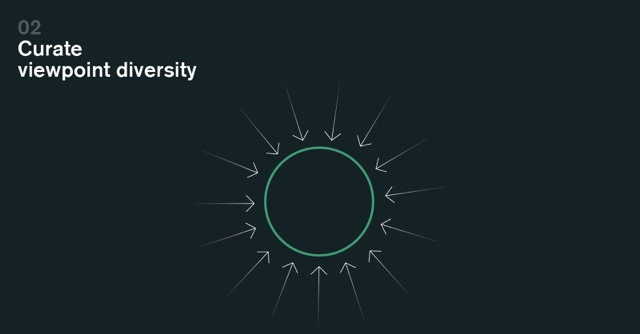
Too much foresight work suffers from wishful thinking. To help avoid projecting our hopes (and fears) onto the future, it’s best to find ways to distance ourselves from our unconscious biases. A good way to do this is to ensure your team holds differing viewpoints so that assumptions can be better explored and interrogated. A useful complement to this approach is to add some external domain experts to the mix, boosting thought-leading viewpoint diversity and credibility.
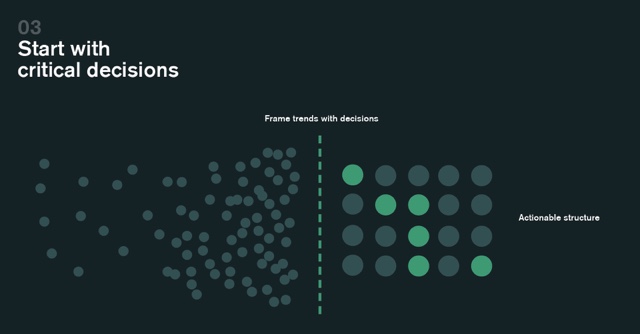
The future is a big place, and there are hundreds of shifts to choose from. To avoid foresight theatre amid a mix of generic trends and hot topics, it’s wise to ground futures work in the strategic choices the business is pretty sure it’ll have to make. These decisions form trend-selection criteria to ensure you focus on the pertinent rather than the flavour-of-the-month buzz topics. You should still be open to uncovering some wildcard trends, but being decision-focused ensures your efforts will be actionable.
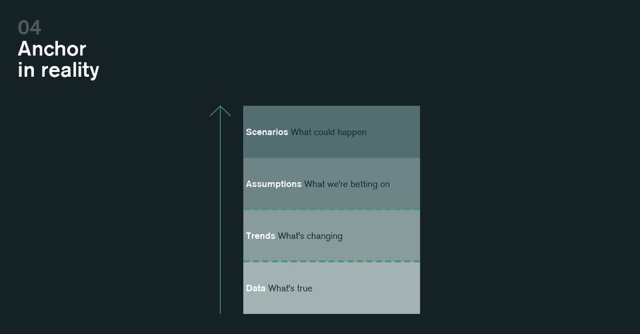
Foresight work inevitably leans into what is changing and can quickly untether itself from reality. To prevent ‘futures intoxication’, ground the work in recent economic, technological and cultural facts to ground it on baseline truths. Reflecting on the tricky job of predicting the rate of change, the futurist Roy Amara cautioned that ‘We tend to overestimate the effect of a technology in the short run and underestimate the effect in the long run.’
Back in 2016, like many others, I was initially swept up in the Autonomous Vehicle hype. This was the year when the CEO of Lyft, an Uber competitor, claimed that most Lyft rides would be in driverless taxis by 2022. That didn’t happen, but 10 years on, in 2026, robocabs are a daily reality in some Chinese and US cities, with US-based Waymo recently announcing it’s now operating 0.5m rides a week across 10 cities.
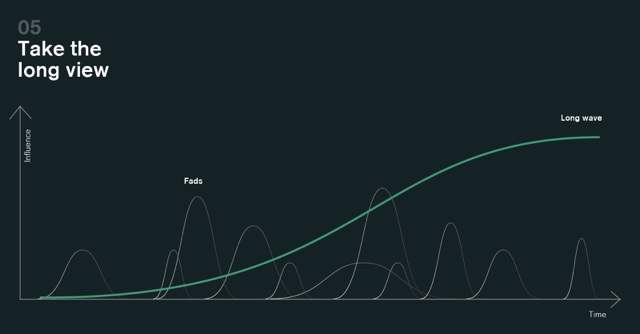
An overemphasis on shiny new bandwagons blights futures work. How much time and resources were burned on the patently woolly notion of the Metaverse? Key decisions are just as likely to be influenced by the evolution of long-established trends as the latest fad setting the podcasts alight. It can often be more insightful and actionable to really understand the recent developments of a long-established trend that is pertinent to your strategic choices, rather than get distracted by the mania of the moment.
In the depths of Covid lockdowns and after a few years of Flygskam (flight shame) appearing in trend decks, I pointed out in a talk that air travel continued to rise after 9/11 and the financial crisis, and would likely do the same post-pandemic. Global passenger traffic surpassed pre-pandemic volumes in 2024 – and is set to double by 2045. It pays to pull up to gain the wider 35,000-ft perspective. To paraphrase Hans Rosling, bad news comes quickly, good news happens slowly.

Once is an accident, twice is a coincidence, and three times is a trend is a well-worn business proverb. Foresight demands more than pattern recognition and description. To understand what’s really driving change, you have to examine how trends develop — their interactions with drivers and inhibitors. Narrowing down to a manageable number of pertinent trends gives you more time to analyse the underlying forces beneath them – both their drivers and their counter-drivers. Digging beneath surface appearances to identify and assess the balance of forces helps you reach firmer judgments on likely trajectories and impacts.
It was only when I dug deeper into the CASE (Connected, Autonomous, Shared and Electric) vision of the future of mobility across numerous projects that so many economic, infrastructural, technological, social, environmental and ergonomic speed bumps surfaced.

One of the most common errors—especially in tech companies—is viewing the future through the lens of the tech hype, assuming (often implicitly) that tech is the primary driver of change. This blinkered view had us living through the Atomic Age, Space Age, Supersonic Age, Information Age, and now the Age of AI. It’s an easy trap: the belief is widely held and loudly trumpeted, plus technology is simpler and more tangible than the messier and more abstract social, cultural, economic, and legislative forces at play.
Technology is not destiny. Many hyped trends never materialise—remember 3D TV or the Hydrogen cars? And, even when they do, they are shaped by other forces. Social, cultural and political shifts often prove more decisive. Few futurists in the 1970s and 1980s anticipated the sweeping rise of women in the workplace and wider society in the decades that followed. Also, consumers are not passive recipients of innovation; they shape it to their own ends. Consider today’s pushback against EVs and heat pumps.
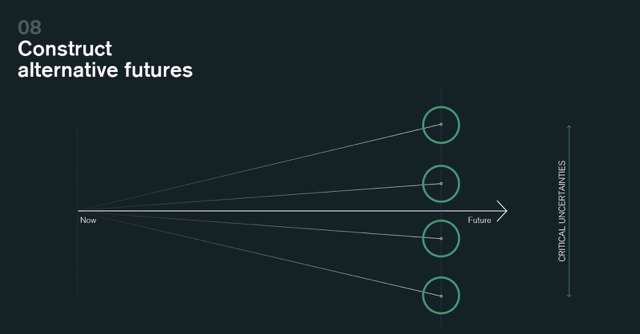
The future cannot be predicted; so don’t sweat crafting perfect predictions. Instead, generate a range of potential futures plotted along dimensions of the main uncertainties you have identified. Building, discussing, and assessing these alternative future worlds challenge assumptions, expand options, and improve judgment. You are not aiming for any one scenario to be a prescient prediction. The future usually includes elements from multiple scenarios, and different customer segments can end up in separate ones. Then assess your hypotheses, decisions or concepts against each scenario to check their robustness across alternative futures.
You’ll overlook some developments, but the very act of working through different scenarios will raise your game. As Dwight D. Eisenhower, WWII general and U.S. president, reflected ‘In preparing for battle I have always found that plans are useless, but planning is indispensable.’

Foresight is not a science; it’s a convincing perspective on future opportunities and risks. To make it strategic, you need to combine far-sightedness with shrewd thinking about the implications and opportunities for your organisation. The same future can affect different companies in very different ways, so your plan should be tailored to your context.
Ultimately, your foresight assumptions will be educated guesses and judgment calls. There’s no data on the future, so it’s down to you to build a credible, coherent, compelling and commercial case for your planning decisions. Credibility comes from facts and expert opinion — the ammunition behind your bold claims. Your story needs to cohere; if the pieces don’t reinforce each other, sceptical executives will find the gaps. Being compelling means reaching beyond logic to your audience’s instincts and ambitions. And being commercial? That’s the part most foresight work skips: articulating how your view of the future translates into competitive advantage and growth.
Since your point of view will be based on facts, if those facts change, your opinions might need to be updated. As the futurist, Paul Saffo sagely put it: ‘hold strong opinions weakly…If you must forecast, then forecast often and be the first to prove yourself wrong.’
Bullet points rarely build buy-in. To convince, tell an engaging story that pulls together all the pertinent threads from disparate sources into a singular thread. This narrative will require more than the core strategy; it will also need some scene-setting to explain why they should care, some killer examples or metaphors to bring your story to life, and some preemptive strikes against anticipated counterarguments. Outline what’s changing, what you’re pretty confident will happen and what the critical uncertainties are. Identify the opportunities and risks of alternative future scenarios. Then, land what it all means for your organisation, your plan, and how it will capitalise on the opportunities and mitigate the risks. If time and budget allow, visualise implications and opportunities to make the future tangible. Finally, polish, practice, and pitch it with pizazz.
Strong foresight isn’t the product of a process; it’s more dependent on experience, domain knowledge, and worldly judgement, but I’ve found these 10 principles to be a useful guide and checklist. If you’re looking to raise your leadership team’s foresight game or to stress-test and build alignment around a longer-term initiative, particularly for teams navigating long-horizon bets in mobility, consumer tech or healthcare, I give a limited number of talks a year on building foresight into long-term strategy (no follow-up pitches).