Critical thinking in an age of AIAI won’t replace critical thinkers; it will reward them

In an age shaped by algorithmic overload, echo chambers and plummeting trust in traditional sources of authority, critical thinking is the new literacy. It is fast becoming essential for citizenship, work, and life in the age of AI.
We have known its value since the ancients, of course, when Aristotle counselled, ‘Be a free thinker and don’t accept everything you hear as truth. Be critical and evaluate what you believe in.’
critical thinking is the new literacy. It is fast becoming essential for citizenship, work, and life in the age of AI
It’s always been wise to be discerning about how we assess and marshal assumptions, opinions, data, facts and ideas – but now we need to add Generative AI (GenAI) content to the mix. In a recent article, I argued that Critical Thinking is one of eight fundamentally human roles in the creative process and should not be delegated to AI.
On the surface, GenAI outputs text, code and imagery which look like other information we’re familiar with, but it demands different questions, such as:
- What do we know about the data the AI models were trained on?
- What do we know about the models’ biases and limitations?
- What was the prompt that generated the content?
- OK, it’s polished, fluent and plausible – but how faithful is it to reality or the truth?
Critical fundamentals
Before we get into how to use GenAI in a discerning way, let’s start with some fundamentals.
Critical thinkers:
- Seek clarity, accuracy and precision – not muddle through
- Ask incisive questions – rather than take things as given
- Evaluate evidence rigorously – instead of trusting instinct over insight
- Stay open-minded – rather than dig in dogmatically
- Work systematically – not sloppily
- Look for nuance – rather than falling into black and white thinking
- Strive for coherence – rather than gloss over contradictions
- Build in reflection — instead of following the same playbook out of habit
The perils of uncritical thinking are legion. They include: falling for marketing hype, mindlessly following groupthink, colleagues not getting a fair hearing, getting the wool pulled over your eyes, dogmatism, incoherent arguments and presentations, building strategies based on wishful thinking and being blindsided by overlooked developments.
 These are core rewards of critical thinking; the next step is cultivating the attitudes that sustain them.
Critical mindset
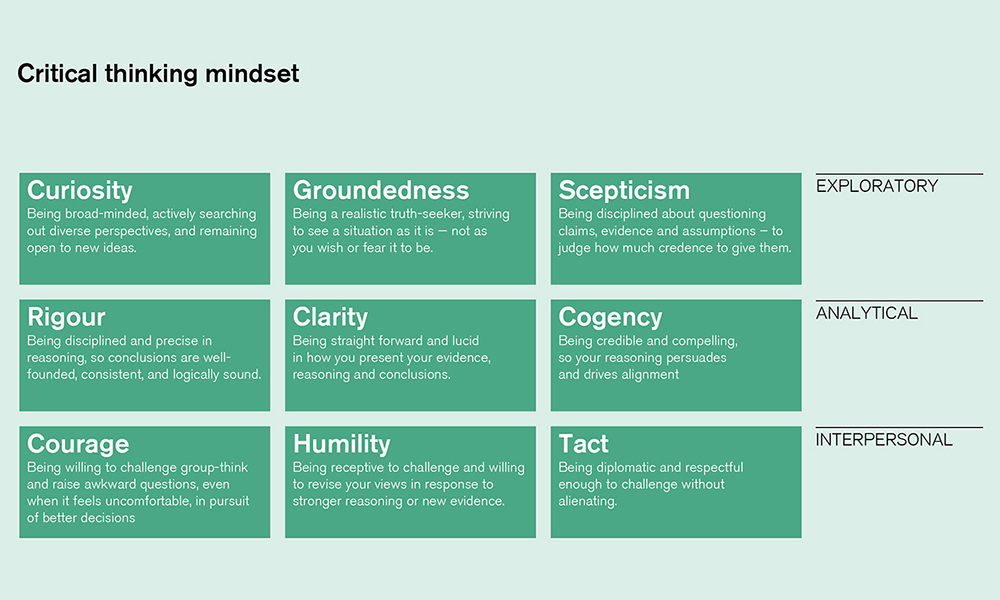
Critical thinkers approach problems with a mix of attitudes, beliefs, and perspectives that GenAI can amplify. Here are nine vital elements of that mindset, with some example prompts to boost critical thinking.
 1. Curiosity
This element involves being broad-minded, actively searching out diverse perspectives, and remaining open to new ideas. The history of innovation is littered with accidental inventions created by people doing deliberate R&D in a related area, who then pursued a tangential ‘that’s strange’ result or phenomenon. One example is the development of CRISPR Gene Editing, which biologists discovered after investigating a ‘curious’ bacterial immune system mechanism with no obvious application.
‘I have no special talent. I am only passionately curious’
Albert Einstein
Prompts to boost curiosity:
- – Summarise the main schools of thought on this issue, outlining their core arguments, and identify one leading proponent of each view.
- – What would this situation look like if I viewed it from [competitor X ]’s perspective? From a regulator’s? From each of our customer segments?
- – Give me three weak signals or emerging trends that could intersect with this product area in unexpected ways.
2. Groundedness
This means being a realistic truth-seeker, striving to see a situation as it is — not as you wish or fear it to be. So much of what we do rests on a heap of assumptions we take for granted. The Wright Brothers were bicycle mechanics who succeeded in getting mankind’s oldest dream off the ground, ahead of much more qualified engineers, by trusting real-world experiments over flawed scientific assumptions and theory.
‘If you get your facts wrong, you get your map wrong; if you get your map wrong, you do the wrong thing.’
Peter Schwartz, futurist, author, and co-founder of the Global Business Network
Prompts to boost Groundedness:
- – Play devil’s advocate and point out the weaknesses in my strategy
- – What are the untested assumptions behind this strategy?
- – Highlight where emotion or bias might be clouding my assessment.
3. Scepticism
This is about being disciplined about questioning claims, evidence and assumptions, and making judgments on how much credence to give them. Scepticism gets a bad rap and is often conflated with cynicism, but challenging hypotheses and orthodoxies lies at the heart of the scientific method and professional rigour. Background knowledge and domain expertise are key here; they help identify content that raises eyebrows, since it’s not practical to check everything. This includes keeping an eye on chatbot sycophancy, the tendency to bend the truth to please users.
Florence Nightingale witnessed more deaths through infections than through combat in a military hospital during the Crimean War in 1854. She gathered data to demonstrate that hospital cleaning substantially reduced death rates, which ran counter to the Miasma or ‘bad air’ theory of disease transmission of the time. Her campaigning led to the introduction of hospital hygiene and, as a result, raised life expectancy in the UK by 20 years.
‘There is no harm in doubt and scepticism, for it is through these that new discoveries are made.’
Richard Feynman, Theoretical physicist
Prompts to boost scepticism:
- – List the possible conflicts of interest or incentives that could have shaped how this data was collected or presented.
- – What alternative explanations might account for the trends we’re interpreting as validation?
- – Imagine you’re a sceptical customer. What would make you hesitate to adopt this product? What criticisms would you post in a review?
4. Rigour
This element focuses on being disciplined and precise in how we develop our reasoning to ensure that our conclusions are well-founded, consistent, and logically sound. Because the Apollo missions pushed the limits of human knowledge, rigorously thinking through the failure modes, redundancies, and many other calculations was the difference between success and disaster.
‘It is the mark of an educated mind to rest satisfied with the degree of precision which the nature of the subject admits.’
Aristotle
Prompts to boost rigour:
-
- – Break this argument into its smallest logical parts — where is the weakest link?
- – What’s the difference between what this data suggests and proves?
- – Apply the same evaluative criteria we used on the last idea to this one. Where do results diverge, and why?
5. Clarity
Being straightforward and lucid in how we present our evidence, reasoning, and conclusions is especially important in an age of AI. Clarity is driven by intentionality, a rounded understanding of goals, purpose, context and audience. GenAI appears intentional, but because it lacks a real sense of purpose or meaning, it can produce content that, on the surface, seems plausible but, on closer scrutiny, lacks clarity. When Steve Jobs pitched the first iPod with the memorable ‘1,000 songs in your pocket’, he demonstrated his deep understanding of goals, purpose, context, and audience.
‘It is still not enough for language to have clarity and content… it must also have a goal and an imperative. Otherwise, from language we descend to chatter, from chatter to babble and from babble to confusion.’
Rene Daumal, French writer, critic and poet
Prompts to boost clarity:
-
- – Turn this chain of thought into a step-by-step argument, showing how each point leads to the conclusion.
- – Highlight any leaps in logic or unexplained jumps between ideas.
- – Suggest ways I could use more straightforward language.
6. Cogency
Being credible and compelling, so our reasoning persuades and drives Being credible and compelling, so our reasoning persuades and drives alignment. Success rarely comes down to having the best solution; it has much more to do with the surrounding story others buy into. For example, Edison’s lightbulb wasn’t the first — but he built a persuasive narrative of a complete system (bulb + generator + wiring), which convinced investors and the public that his solution was credible and viable at scale.
‘Don’t raise your voice, improve your argument.’
Desmond Tutu, South African Anglican bishop and theologian
Prompts to boost cogency:
-
- – Act like a CEO and identify counter-arguments or objections they might raise, and how I might address them upfront.
- – Turn this argument into a three-point narrative that builds momentum toward a shared conclusion.
- – Suggest metaphors, examples, or analogies that would make this argument more vivid and memorable.
7. Courage
This overlooked element of the critical thinking mindset is the willingness to challenge groupthink and raise awkward questions, even when it feels uncomfortable, in pursuit of better decisions. In the early days of Airbnb, investors and hospitality experts dismissed the idea of strangers paying to stay in each other’s homes. The founders persisted by asking uncomfortable questions about why people wouldn’t share space and reframing trust in an online world.
‘Whenever you see a successful business, someone once made
a courageous decision.’
Peter Drucker, Austrian-American management consultant, educator, and author
Prompts to boost courage:
-
- – What assumptions could we be accepting too readily because everyone seems to agree?
- – If this strategy fails, what’s the awkward but most likely reason?
- – Which stakeholder voices are missing from this discussion, and how might they challenge our assumptions?
8. Humility
Open-mindedness is central to critical thinking. Being receptive to challenge and willing to revise your views in response to stronger reasoning or new evidence. For example, Netflix could have doubled down on its profitable DVD rental model. Instead, CEO Reed Hastings accepted stronger evidence that broadband adoption and consumer behaviour were shifting and pivoted early to streaming.
‘When the facts change, I change my mind – what do you do, sir?’
Maynard Keynes, British economist
Prompts to boost humility:
-
- – What are the strongest counterarguments to my position, and which of them should I take most seriously?
- – If I’m wrong here, what’s the most likely way I’m wrong?
- – Reframe my conclusion as a hypothesis rather than a certainty — how would that change the tone?
9. Tact
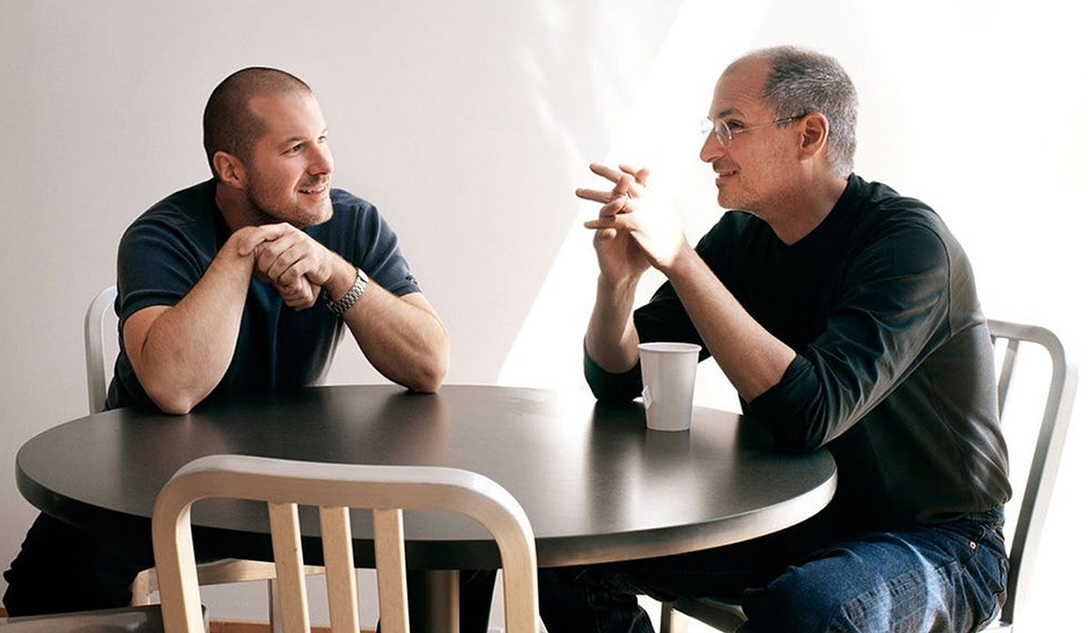
Being an effective critical thinker requires diplomacy and respect when challenging others without alienating colleagues and stakeholders. Jony Ive often disagreed with engineers or Steve Jobs, but framed challenges respectfully, through prototypes and visuals rather than blunt argument, often winning them around.
‘Tact is the knack of making a point without making an enemy’
Isaac Newton
Prompts to boost tact:
-
- – How can I phrase this question to highlight concern for the outcome rather than criticism of the person?
- – What parts of my wording might trigger defensiveness, and how could I adjust them?
- – Draft a version of this challenge that ends with a forward-looking suggestion instead of a dead-end critique.
AI won’t replace critical thinkers; it will reward them.
So critical thinking is as much an art as it is a science. It’s a mix of exploration, analysis, and interpersonal skills. It’s long been the mark of effective leaders and operators, but GenAI raises the stakes and raises new questions. Like when and how to use it? How to prompt it? How to assess its outputs? And how should the results be integrated with human outputs?
A guiding principle I hold to is that we should aim to lead the use of AI, rather than be unconsciously led by it. For example, not turning to it with a blank slate, but with an initial point of view, idea or hypothesis and then using it to play devil’s advocate and gather additional insights. Using it unwisely or lazily can result in ‘workslop’ and a tarnished reputation with your colleagues. Used judiciously, GenAI can stimulate critical thinking and strengthen your credibility.
In my follow-up article, I outline nine critical thinking habits to engrain in your approach.
PS. This article began life as a ‘lunch and learn’ talk I gave to a client team. Let me know if you’d like me to present it to your team (or class).
Related Views

What I wish I’d been told when I graduated into a recession

My advice to designers graduating into the AI era

A mindset is intent; habits are execution. Critical thinking needs both

Eight creative roles GenAI shouldn't play

Increasing your teams’ impact on the organisation

Routes out of the doldrums

Over used for brainstorming, under used elsewhere

Improve the odds of your workshop flying